Loading image...

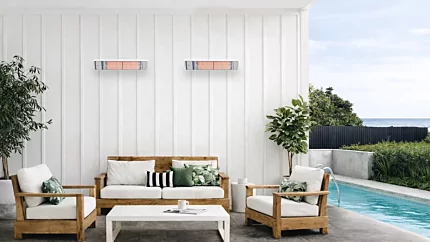
Spot 2800W Radiant Heater
Most outdoor heater sizing guides give you one formula. Multiply your square metres by a wattage factor, pick a model, done. That formula was built for indoor convection heating, where warm air stays put and a thermostat tells you when to stop. Outdoors, none of that holds.
Sizing an outdoor radiant heater means accepting that BTU per square metre is a starting point, not an answer. Four variables change the maths before the formula even applies: the IP rating that decides where a heater is legally allowed to live, the mounting height that controls how much radiant intensity reaches a guest at seated level, the space type that dictates how quickly heat escapes laterally, and the wind exposure that breaks every convection-based assumption you might be carrying over from indoors. Get any of these wrong and you end up burning power to heat air that drifts away in a breeze, or buying a heater you can't legally install where you wanted it.
There's a useful frame for this. Radiant heating is the same principle that warms you standing in winter sunshine while the air around you is still freezing. The sun isn't heating the atmosphere; it's heating you. By the end of this guide, you'll be able to calculate the right output for a specific outdoor space, choose between the Heatscope Spot, Vision, Next, Pure, and Pure+ ranges where available in your market, and avoid the most common mistake of undersizing an exposed deck or oversizing a sheltered alcove.
Loading image...
Spot 2800W Radiant Heater
Outdoor radiant heaters warm people and surfaces directly with infrared energy, so sizing them by air volume gives the wrong answer. Outdoor sizing depends on radiant footprint, mounting geometry, and the heater's IP rating, not on cubic metres of air.
Convection and radiant are different physical processes. A convection heater warms the air, then relies on the warm air to reach occupants. Indoors, this works because the air has nowhere to go. Outdoors, the air drifts the moment a breeze picks up, and the heat goes with it. Radiant heaters skip the air entirely. The infrared energy travels at the speed of light to people and objects, which then store and re-radiate that heat. This is why our outdoor radiant heaters feel warm to the skin within seconds and stay effective when the air around them is moving.
The 20 BTU per square foot rule of thumb you'll find on most sizing pages was built for enclosed rooms. It assumes air retention, no wind, and a thermostat to close the feedback loop. Outdoors none of those conditions apply. ASHRAE guidance on outdoor infrared notes that radiant systems require materially less input than forced-air to reach the same occupant comfort, because the heat reaches people directly rather than via a working fluid that will inevitably drift away.
So before any sizing calculation, four variables sit upstream of the maths:
IP rating as the gating question of whether the heater belongs in the location at all
Mounting height as the control on how much intensity reaches seated guests
Space type spanning covered, semi-covered, and fully open configurations
Wind exposure which decides whether convection assumptions apply at all
Each variable changes the wattage factor you'd otherwise pull from a table. Walking through them in order is the discipline that separates a correctly sized installation from a costly mistake.
One watt of electric radiant output equals 3.413 BTU per hour. A 3,000 W heater produces 10,239 BTU/hr (3.0 kW). According to Heatscope's installation guidelines, plan on roughly 100 to 150 watts per square metre in a sheltered space, 200 to 300 W/m² in a semi-exposed space, and 300 to 400 W/m² in a fully exposed space.
A BTU, or British Thermal Unit, is the energy required to raise one pound of water by one degree Fahrenheit. BTU per hour (BTU/hr) is the heating-output rate most North American and gas-product spec sheets default to. Watts are the same idea expressed in metric, where one watt equals one joule per second. The conversion is simple: multiply watts by 3.413 to get BTU/hr, or divide BTU/hr by 3.413 to get watts back. Electric radiant heaters are rated in watts because they draw a measurable electrical load. Gas heaters are rated in BTU/hr because the input is a fuel-flow rate. The point of this article is to make either unit usable.
Wattage | BTU/hr | Approx. Heatscope model |
|---|---|---|
1,600 W | 5,461 BTU/hr (1.6 kW) | Spot 1600 (US/CA only) |
2,400 W | 8,191 BTU/hr (2.4 kW) | Pure 2400 |
2,800 W | 9,556 BTU/hr (2.8 kW) | Spot 2800 |
3,000 W | 10,239 BTU/hr (3.0 kW) | Pure+ 3000, Next 3000 |
3,200 W | 10,922 BTU/hr (3.2 kW) | Vision 3200 |
The "20 BTU per square foot" indoor rule translates poorly because it assumes the heater is conditioning air, not directly heating people. For outdoor work, the band that actually performs sits at 100 to 400 W/m², set by exposure rather than floor area alone. One useful aside: the 50% dual-stage setting on the Heatscope range halves amp draw, which makes a difference on mild evenings when full output would over-heat the zone and waste electricity. The full sizing table comes later in this guide, after the four variables have done their work.
Most sizing guides hand you one number and stop. That's the article-length version of telling a cook to weigh the flour and ignore everything else. The reality of outdoor heating is that four variables modify the wattage figure before you've even opened a product page. Walking through them in the order they matter is the only way to land on a sizing answer that holds up once the heater is mounted and the breeze picks up.
IP rating drives placement before any sizing maths begins. A heater you can't legally install in a location can't heat it, no matter how well the wattage figure works on paper.
Across the Heatscope range, three IP ratings cover the placement spectrum. IP24 covers the Spot 2800 and Vision 3200, with splash protection from any direction, which suits covered patios and pergolas with solid roofs but rules out fully exposed installs. IP25 covers the Next 3000, adding water-jet protection from any direction for semi-exposed and exposed deployment in markets where that model is sold. IP65 sits at the top with the Pure+ 3000, the only model in the range rated for fully exposed outdoor installation such as open decks, uncovered terraces, and coastal sites where rain and salt spray are constants.
IP rating | Heatscope model | Suitable locations |
|---|---|---|
IP24 | Spot 2800, Vision 3200 | Covered patios, pergolas with solid roof, enclosed verandahs |
IP25 | Next 3000 (US/CA only) | Semi-exposed terraces, decks with partial cover |
IP65 | Pure+ 3000 | Fully exposed outdoor installs, open decks, coastal sites |
This is where sizing tables can mislead. An exposed deck rules out the Vision and Spot ranges immediately, regardless of how well the wattage maths works out, and the wattage budget has to be rebuilt around the IP65 model that is allowed to be there.
Radiant intensity falls with the square of distance from the heater. A heater mounted at 2.4 m delivers materially more felt heat at seated height than the same heater mounted at 3.2 m, not because the heater's output changed, but because the energy spreads across a larger surface the further it has to travel. This is straight inverse-square geometry, and it's the variable specifiers most often underestimate when working from a floor-area figure alone.
Heatscope's installation clearances set the practical bounds. Minimum floor clearance is 1,800 mm to keep heat away from heads and seated guests. Vision and Spot ceiling minimums sit at 2 m [79 in] to a horizontal surface. The Pure+ keeps a 1,800 mm minimum from the ground for its all-weather configuration. Effective directional projection per heater is up to 3 m, which sets the outer edge of the comfort zone for a single unit.
The practical implication is that a 3.5 m pergola ceiling needs more wattage than a 2.4 m verandah ceiling for the same floor area, or it needs extension rods to drop the heater closer to seated guests. Heatscope offers 100, 300, and 500 mm extension rods across the range exactly for this reason. Extension rods are not a workaround; they're a sizing tool that lets one wattage tier cover two ceiling heights without forcing a step up the product ladder.
This is the single most underrated sizing variable. A 30 m² space is not a 30 m² space. It depends what's around it. The same floor area in a sheltered alcove and an open deck needs roughly twice the wattage in the second case to deliver the same felt warmth at seated height.
Three categories cover most outdoor installs.
A covered patio or enclosed pergola with a solid roof and walls or screens on two or more sides sits around 100 to 150 W/m². Heat lingers, radiant works almost as efficiently as indoors, and a single mid-range unit covers most domestic floor areas. Our wind-protected patio heaters collection covers the models specified into this configuration in detail.
A semi-covered space with a solid roof but only one wall or no walls runs 200 to 300 W/m². Some heat loss to lateral airflow happens regardless of how generous the roof is, and the sizing budget has to absorb it. Two zoned heaters often outperform one larger heater across the same area, because directional projection is 3 m per unit and a single heater can leave the far corners cold. The full lineup of semi-open patio heaters covers the models pitched at this configuration.
An open deck or uncovered terrace with no roof and no walls climbs to 300 to 400 W/m². IP65 is mandatory, which narrows the model choice to the Pure+ in the Heatscope range. The realistic strategy for fully exposed spaces is directional coverage of the seating zone rather than whole-area coverage, since heating the empty parts of a deck is wasted output. The open patio heaters cluster lists the IP65-rated specification options for this case. Multiple zoned units beat a single large unit every time in this configuration.
This is the variable that breaks every gas patio heater sizing formula. Convection heat, the warm air rising off a flame, is dispersed by even a light breeze, so gas heaters lose effective output as wind picks up. Industry sizing guidelines for horizontal infrared heaters quantify this clearly: an exposed location can drop coverage from a 12 ft × 12 ft footprint per unit down to 8 ft × 8 ft for the same horizontal heater, a 56% reduction in effective area for the same nameplate output.
Mid-wave infrared works differently. The infrared energy travels at the speed of light to people and objects; the air it passes through is incidental. Wind doesn't reduce the heat that reaches a guest's skin in the way it reduces the heat reaching the same guest from a gas flame. A cold wind can still affect perceived warmth, much like a chilly wind on a sunny day, but the radiant energy itself is not stripped out of the heat path by air movement.
The practical implication is that Heatscope's wind-coastal sizing rule is effectively the same as its still-air sizing rule. A 30 m² windy deck needs the same wattage as a 30 m² sheltered deck, provided the IP rating and mounting height are correct. This is also why the Pure+ 3000W radiant heater is specified for exposed coastal projects in Sydney, Melbourne, and Mediterranean Europe: the IP65 housing handles salt spray and rain, and the mid-wave output reaches occupants regardless of how busy the wind is.
For Heatscope electric radiant heaters, plan on roughly 100 to 150 W/m² for a covered patio, 200 to 300 W/m² for a semi-covered space, and 300 to 400 W/m² for a fully exposed outdoor area. Multiply your floor area by the wattage factor that matches your space type to estimate the total output required, then check the IP rating against the location.
Space type | Wattage / m² | Example area | Total output needed | Recommended Heatscope model(s) | IP requirement |
|---|---|---|---|---|---|
Covered patio / sunroom | 100 to 150 W/m² | 8 m² | 800 to 1,200 W (2,730 to 4,096 BTU/hr) | 1 × Spot 1600 (US/CA) or 1 × Pure 2400 | IP24 acceptable |
Covered patio / verandah | 100 to 150 W/m² | 15 m² | 1,500 to 2,300 W (5,120 to 7,850 BTU/hr) | 1 × Spot 2800 or 1 × Pure 2400 | IP24 acceptable |
Enclosed pergola | 120 to 180 W/m² | 20 m² | 2,400 to 3,600 W (8,191 to 12,287 BTU/hr) | 1 × Vision 3200 or 2 × Spot 2800 | IP24 acceptable |
Semi-covered terrace | 200 to 300 W/m² | 15 m² | 3,000 to 4,500 W (10,239 to 15,358 BTU/hr) | 2 × Spot 2800 or 1 × Vision 3200 + 1 × Spot 2800 | IP24/IP25 |
Semi-covered hospitality area | 200 to 300 W/m² | 30 m² | 6,000 to 9,000 W (20,478 to 30,717 BTU/hr) | 3 × Vision 3200 or 3 × Next 3000 (US/CA) | IP25 preferred |
Open deck / uncovered terrace | 300 to 400 W/m² | 10 m² (zoned) | 3,000 to 4,000 W (10,239 to 13,652 BTU/hr) | 1 × Pure+ 3000 zoned to seating | IP65 required |
Open coastal / exposed | 300 to 400 W/m² | 20 m² (zoned) | 6,000 to 8,000 W (20,478 to 27,304 BTU/hr) | 2 × Pure+ 3000 | IP65 required |
A worked example makes the table easier to apply. Picture a 25 m² semi-covered restaurant terrace in Melbourne, with a solid roof, two open sides, and direct exposure to wind off the bay. Multiply 25 m² by 250 W/m² (middle of the semi-covered band) for a target of 6,250 W. That puts the answer at either 2 × Vision 3200 (6,400 W combined) or 2 × Next 3000 (6,000 W). IP25 is the cleanest specification for that exposure, so the Next 3000 would be the natural pick, but the Next 3000 is sold only in the US and Canada. In Australia, the Vision 3200 with the Weathershield accessory is the right answer, mounted 2.4 to 2.8 m above seated height and angled across the seating zone.
Note: the Pure 2400 is an IP65-rated all-weather model and suits more exposed configurations than the IP24 column suggests; it is listed alongside the IP24 models in the covered-patio rows because it is a viable option there, but it is not limited to covered use.
Three notes sit alongside the table. All figures assume a mounting height of 2.4 to 2.8 m; higher ceilings need either extra wattage or extension rods to keep the radiant intensity at seated level intact. Multi-zone installs are preferred over single-heater installs above 20 m², because directional projection is 3 m per unit and one heater can't reach the corners of a large space. And 50% dual-stage output extends comfort range without rewiring, which is useful for shoulder-season evenings when full output is overkill.
The sizing table gets you to a wattage target. Model selection translates that target into hardware. The Heatscope range splits into five product lines, each pitched at a specific combination of placement, aesthetic, and IP requirement.
The Spot 1600 and Spot 2800 are directional high-performance heaters at IP24, designed for covered patios and commercial under-cover spaces where pure heating performance matters more than visual presence. The Spot 1600 is sold in the US and Canada only, while the Spot 2800 ships globally and tends to be the workhorse choice for verandahs and enclosed pergolas.
The Vision 3200 swaps the Spot's industrial grille for a discreet glass-ceramic front at the same IP24 rating, which suits residential and hospitality interiors and covered patios where the heater shares a sightline with the architecture. Specifiers reach for the Vision when the brief asks for warmth without a visual statement.
The Next 3000 is the ultra-slim aluminium chassis option at IP25, pitched at semi-exposed and exposed contemporary spaces. It's sold in the US and Canada only, which means specifiers in Australia, the UK, and the EU work around it by stepping up to the Pure+ when an exposed install is on the table.
The Pure 2400 and Pure+ 3000 sit at the all-weather end of the range. The Pure+ at IP65 is the only Heatscope model rated for fully exposed installs, with a convex glass screen that handles direct rain, salt air, and the kind of wind that would shut down a gas patio heater entirely. For open decks, coastal projects, and rooftop terraces, the Pure+ is the only specification that fits.
A short decision tree pulls it together. If the space is fully open, the Pure+ is the only answer. If the space is semi-covered, the Vision or Next handles it depending on market. If the space is fully covered, the Spot or Vision both work, and the choice comes down to whether visual discretion matters more than maximum heating density. Specifiers and homeowners working outside North America should treat the Spot 1600 and Next 3000 as out of scope and plan around the Spot 2800, Vision 3200, Pure, and Pure+ instead.
Five mistakes show up consistently in failed installs. Each one has a one-sentence diagnosis and a one-sentence fix.
Sizing by floor area alone. The single most common mistake is picking a wattage figure from a square-metre formula and skipping the four variables that modify it. Run the IP rating, mounting height, space type, and wind exposure check first; the spec sheet comes after.
Specifying IP24 for an exposed location. A Spot 2800 or Vision under a freestanding pergola without a solid roof will fail in the first storm, regardless of how well the wattage maths worked. Only the IP65-rated Pure+ is rated for fully exposed installs, full stop.
One large heater for a long, narrow space. Directional projection is 3 m per unit, so a single heater cannot cover a 6 m × 2 m terrace evenly. Two zoned heaters with overlapping projection deliver a more uniform comfort zone than one oversized unit at the same total wattage.
Mounting too high. A heater at 3.5 m delivers materially less felt heat at seated level than the same heater at 2.4 m, because radiant intensity falls with the square of distance. Drop the heater closer to seated height with the appropriate extension rod, or step up a wattage tier if the ceiling can't accommodate a lower mount.
Forgetting electrical capacity. Three 3,000 W heaters on a single 16 A circuit will trip the breaker the first time they all run together. Plan circuits before mounting locations and bring a licensed electrician in early; the wiring detail belongs in the install conversation, not in the sizing calculation.
Loading image...


Hospitality sizing differs from residential in three ways that the table alone doesn't capture. Commercial venues run heaters across long evenings, not for an hour after dinner, so the duty cycle and the standby behaviour of the heater both matter. The mid-wave infrared element on the Heatscope range hits full output instantly and switches off the same way, which is what allows zone activation to track table occupancy rather than running everything at full power for a six-hour service window.
Zoning is the second difference. A single remote can pair with multiple Heatscope heaters across a terrace, and ZigBee motion sensors automate zone activation so that a heater warms the booth a guest just sat down at rather than the empty section across the room. Specifiers designing a restaurant heating layout can map comfort zones directly to the table plan and let the sensors handle the rest. ASHRAE guidance on zoned infrared frames this approach as heating the people rather than the building, which for a hospitality venue with variable occupancy is what makes the heating spec commercially sensible.
The third difference is compliance and aesthetics. IP rating becomes a specification document line item rather than a label on a spec sheet, and the choice between black, white, and glass-ceramic finishes is made against the architectural palette. Heatscope's German-engineered carbon fibre elements are rated for 10,000 plus hours of operation, the Red Dot Design Award sits on the brand's mantelpiece, and the visual presence of a Vision or Pure+ in a five-star terrace is part of the specification, not an afterthought. A specifier who undersizes a restaurant terrace doesn't just lose comfort; they lose covers on the cold nights when the terrace was meant to extend the season into shoulder months.
A short checklist closes the loop for specifier-grade projects:
Confirm IP rating against the most exposed point in the install, not the average exposure
Plan zoning around the table layout, not the floor plan
Specify finish against the architectural palette before specifying wattage
Sizing an outdoor radiant heater is a four-variable problem before it becomes a wattage problem. Check the IP rating against the location, then check the mounting height against the ceiling, then check the space type against the wattage band, then check the wind exposure against the technology. Only after those four checks does the multiply-by-W/m² calculation deliver a usable answer.
This approach beats the single-formula sizing pages because it accounts for how outdoor radiant heat actually behaves rather than borrowing assumptions from indoor convection sizing. With the wattage-to-coverage table and the model-selection logic above, you have what you need to size a system for a residential patio or specify a heating layout for a commercial terrace. The Heatscope range covers the full IP24 to IP65 spectrum, and the right model for a space falls out of the four-variable check rather than from a guess at the spec sheet.
For the full Heatscope lineup, including the Pure+ 3000 for exposed installs and the Vision 3200 for covered work, the radiant-heaters category page lists current specs, accessories, and regional availability. Specifier support is available directly from the Heatscope team for projects that need a heating-layout drawing or a wattage budget against an architectural plan.