Loading image...

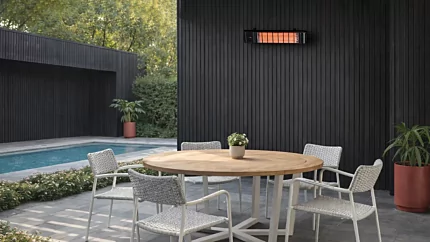
Almost everyone has lived the gas-mushroom moment. You shuffle close, your shins feel warm, and three steps away the night air is exactly as cold as it was before the heater turned on. The marketing said the unit pumps out thousands of watts, and yet the moment a breeze rolls across the terrace the warmth simply evaporates.
That mismatch between rated output and felt warmth is not a fault in the heater. It is a fault in the choice of heating method for an outdoor space. Indoors, a heater can warm the air and let convection do the rest. Outdoors, the air refuses to stay put long enough to do anything useful.
This article closes the gap between marketing language and physics. We look at why wind has no purchase on radiant infrared, what the IP code on a heater's spec sheet actually tells you about real installations, and how to match an outdoor space's wind exposure to the right heater rather than guessing at wattage.
Loading image...
Convection heaters warm a parcel of air sitting next to the element. Warm air rises, cooler air drops in to take its place, and indoors that loop fills a room. Outdoors the loop never closes. Wind drags the heated air sideways and replaces it with fresh, cold air faster than the heater can re-warm anything. The element can be glowing red and the seated guest still feels the original ambient temperature.
Radiant infrared heaters do something different. The element emits energy in the mid-wave infrared band, roughly 2 to 4 microns. Air is largely transparent to those wavelengths, so the energy passes through it without warming it. The infrared travels in a directional beam from the unit until it lands on a solid surface, a person, a tabletop, a wall, and that surface absorbs it. The warmth you feel is the heat re-radiating from skin and material, not from heated air swirling around you.
The sun analogy is overworked but accurate. On a cold, windy day you still feel the sun on your face because radiation reaches you directly. The breeze cannot push sunlight away. Mid-wave infrared works on the same principle at a much shorter range.
Wind cools an outdoor space by replacing warm air with cold air. Infrared heaters are immune to this because they don't warm the air. They emit radiant energy that passes through air and is absorbed directly by people and surfaces.
Where this gets useful is in the published efficiency numbers. Across our outdoor radiant heaters, the Pure+ and Next series convert at least 90% of input energy into radiant heat, the Spot series at least 94%, and the Vision series 87% or higher. Those are the percentages that determine whether a heater works on a breezy terrace.
Convection | Radiant infrared | |
|---|---|---|
What it warms | The air around the unit | People, furniture, surfaces |
What wind does to it | Carries the warm air away | Nothing, air is transparent to mid-wave IR |
Typical outdoor result | Effective only in still, enclosed pockets | Holds warmth at the seating zone regardless of breeze |
Indoor relevance | Works well in still rooms | Works well, but convection is usually cheaper indoors |
A brief aside, because it reframes the technology. The same mid-wave band is used in aerospace coating cure and industrial drying lines precisely because it deposits energy into a target without heating the surrounding atmosphere. Outdoor heating is the consumer-grade application of an industrial physics principle.
“Weather-resistant” is a marketing label, not a specification. Two heaters with that phrase on their listings can have completely different installation envelopes, and the only way to know which one belongs on your space is the IP rating.
An IP rating is a two-digit code defined by IEC 60529. The first digit rates protection against solids, including dust. The second digit rates protection against water. Higher is more protected. For outdoor radiant heaters, three ratings cover most real-world decisions: IP24 suits sheltered patios, IP25 handles moderate exposure, and IP65 is the only rating safe for fully exposed installations.
The distinctions matter because wind exposure is rarely just wind. A breezy site usually means wind-driven rain, sometimes salt aerosol near the coast, often airborne dust on commercial rooftops. The IP rating tells you whether the unit survives the conditions that come bundled with the wind, not just the wind itself.
Rating | What it protects against | Best install environment |
|---|---|---|
IP24 | Splashing water from any direction | Sheltered patios, covered balconies, commercial terraces with a roof |
IP25 | Low-pressure water jets from any direction | Moderate exposure, partial cover, occasional rain blow-in |
IP65 | Dust-tight, water jets from any direction | Fully exposed: rooftops, open decks, uncovered patios, coastal terraces |
Across the range, the Spot 1600W, Spot 2800W, and Vision 3200W sit at IP24 for sheltered installations. The Next 3000W steps up to IP25 for moderate exposure. The Pure+ 3000W reaches IP65, dust-tight and rated for water jets, which is the line you need to clear before mounting a heater somewhere fully open to the weather. The Vision also has an optional Weathershield accessory that extends its usable envelope when the mounting position is exposed but not extreme.
The reflex with outdoor heating is to ask which model is most powerful. That is the wrong question. The right one is what the space throws at the heater. Power matters once exposure is settled, not before.
Sheltered spaces, the covered patio with a solid roof, the balcony with an overhang, the pergola with a closed canopy, filter most of the wind before it reaches the seated zone. IP24 is sufficient here, and any IP24 unit in our wind-protected patio heaters range will hold its warmth comfortably. The Spot series suits small to mid spaces; the Vision 3200W is the design-led choice where the heater needs to disappear into the architecture. Pergola-specific clearances and beam aiming sit in our dedicated pergola article.
Moderately exposed spaces, the partly covered terrace, the open-sided pergola, the restaurant courtyard with a single wall, are where directional infrared earns its keep. Wind reaches the seated zone but rain is mostly deflected. IP25 gives the safety margin against the occasional blow-in, and the Next 3000W is the model built for that brief. Aim matters more than wattage here. A Next 3000W pointed straight at the seating zone outperforms a higher-rated unit firing across it. Our semi-open patio heaters range groups the models built for this exposure band.
Fully exposed installations are a different problem. Rooftop bars, open decks, coastal terraces, uncovered courtyards, all of them get wind, wind-driven rain, salt, and dust in combination. IP65 is the only appropriate rating, which is why the Pure+ 3000W radiant heater is the deep specification for that scenario. Dust-tight enclosure, jet-resistant seal, and a Red Dot Design Award that makes it specifiable when the heater is part of the architecture rather than hidden in a soffit.
A short reminder, because IP rating sets the envelope but does not set the power. Coverage area, mounting height, and watt-density at the seating zone determine whether the chosen heater warms the people in front of it:
Mounting height determines beam spread at the seating plane.
Watt-density per square metre determines perceived warmth.
Total coverage area determines how many units you need.
For brand-led hospitality groups, there is a related point worth flagging. Electric infrared has zero direct combustion at the point of use, which lands well against ESG reporting frameworks where gas patio heaters increasingly show up as a flagged line item.
Wind exposure is the hospitality problem nobody quite addresses on the wider web. Rooftop bars, beachfront terraces, and open-sided dining rooms are the highest-revenue outdoor spaces and the most punishing on heating equipment. Specifiers working those briefs need more than “weather-resistant.”
A handful of practical notes from spec work on exposed hotel and restaurant heating projects:
IP65 is non-negotiable on fully exposed installations. A lower rating invalidates the install the first time wind-driven rain finds the enclosure.
Higher mounting positions and exposed sites usually call for higher-output models with stronger beam reach. The geometry pushes you up the range, not down.
Directional aim is the single biggest lever outdoors. A Next 3000W pointed at a seating zone outperforms an omnidirectional unit twice its wattage that fires into ambient air.
A 15-second warm-up matters in service settings. Heat is on the guest before the guest is seated, which means no preheat ritual before each sitting.
All-electric specifications skip the gas line, the flue, and the combustion ventilation calculation. Site approval tends to be quicker in dense urban hospitality fit-outs.
Installation discipline still applies. A licensed electrician, an RCD or GFCI on the circuit, and clearance to combustible surfaces per the manual. Mounting clearances and load detail live in our installation guide rather than here, but the principle is consistent: the heater earns its IP rating only if the install respects it.
Outdoor heating does not fail because the heater is weak. It fails when the heater warms a medium, the air, that wind keeps replacing.
Radiant infrared sidesteps the problem because it warms people and surfaces directly. IP24, IP25, and IP65 tell you which version of that radiant heater suits which version of your space. Match the rating to the exposure first, then choose the model that fits the room.
The next decisions are sizing and mounting. We publish radiant efficiency, IP ratings, and beam reach on every model so the outdoor heating decision can be made on the physics rather than the promises.