Loading image...

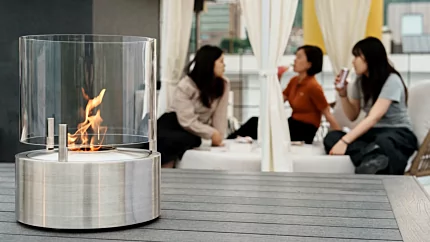
T-Lite 8 Designer Fireplace
/
Designer Fireplaces for Hospitality: How Hotels, Restaurants, and Bars Use Fire to Create AmbiencePicture the moment a guest crosses the threshold into a hotel lobby and stops, mid-step, because a real flame is the first thing they see. Not a screen, not a backlit installation, not a flicker of LED behind frosted glass. An actual fire, throwing real warmth across a stone hearth, anchoring the room. That single sensory cue is doing more for the property's brand than the chandelier above it, and operators are starting to notice. Designer fireplaces for hospitality have moved from decorative afterthought to revenue-generating fixture, and the technology underneath that shift is bioethanol, not gas.
The assumption that real flame requires a flue, a gas line, and a six-figure compliance pathway is the reason most lobbies still rely on screens or fake logs. It is also wrong. Modern hospitality fireplace specifications start with closed-combustion burners that need no chimney, no gas connection, and no licensed installer beyond an electrician for control wiring. The result is a real-flame fixture that fits the budget, the floor plan, and the certification regime every time, across every venue in a portfolio.
Loading image...
T-Lite 8 Designer Fireplace
Fire is the oldest gathering point a hotel can install, and the data has caught up to the intuition. Industry analysis from Cooke Furniture reports that guests linger 89% longer at seating arranged around a fire feature, an average lift from 45 to 85 minutes, and spend 47% more on food and beverage per visit. The same research puts fire features at 92 out of 100 for perceived luxury, ahead of premium seating at 78 and water features at 75. Those are directional numbers rather than a single peer-reviewed study, but the direction is unambiguous.
The biophilic case is stronger still. The Interface Human Spaces 2.0 report classifies fire as a Non-Visual Connection with Nature, defined as “crackling fires providing visual and (sometimes) auditory stimuli as well as thermal variability”, and recorded a 36% higher dwell rate in biophilic hotel lobbies compared with conventional layouts across six Midtown Manhattan properties. Guests reviewing biophilic hotels mention “experience” twice as often as guests reviewing conventional ones. Christine Killion put it more plainly in LODGING Magazine: “There’s nothing like a fire to bring people together.”
A hospitality-ready fireplace meets six criteria: no flue or chimney, no gas line, internationally recognised certifications, burn time long enough to span a full service window, cool-touch safety on accessible surfaces, and a burner system that scales across multiple units without re-engineering each install.
That last point is what separates a one-off feature from a portfolio specification. A property installing fire in the lobby, the lounge, the rooftop bar, and twelve premium suites cannot afford four different compliance pathways. EcoSmart Fire’s certifications cover UL 1370 for North America, EN 16647 for Europe, and ACCC compliance for Australia, with one specification sheet valid across all four regions. The burners themselves carry across the range, so the AB3 unit serving a freestanding lobby piece is the same combustion engine sitting inside a built-in insert in the bar, simplifying spares, training, and back-of-house logistics.
The cool-touch requirement matters more in hospitality than in residential use because guests will reach for the flame in ways homeowners do not. Our designer ethanol fireplaces keep accessible surfaces below scalding thresholds during operation and provide a sealed fuel reservoir that cannot be opened while burning, addressing the public-access concern that traditionally pushed operators toward gas or electric. Stephane Thomas, Director of MAD Design Group, frames the appeal directly: “The main reason our clients choose bioethanol fireplaces is because they’re clean-burning and can be installed in places traditional fireplaces cannot be. Most other types require a connection to gas or electricity, which can limit options for designers. EcoSmart ventless fireplaces require no connections or venting, which further enhances the design options.”
The lobby fireplace is the property’s handshake, and the fixture has to perform from the moment doors open until the last late check-in. Our freestanding lobby pieces and built-in inserts span sculptural sphere-style freestanders with eight to eleven hour burns, vertical pillar columns that anchor a corner without consuming floor area, and stainless steel framed inserts sized for double-height lobby walls. Each option runs on the same closed-combustion burner platform, so the maintenance protocol the engineering team learns on the lobby unit transfers directly to the suite installations upstairs.
In-room fire features have become a booking differentiator on luxury OTAs, and the absence of a flue requirement is what makes the suite-level rollout commercially possible. Our minimalist insert and rounded ceramic models suit boutique suites where a chimney was never an option, and the InterContinental Yokohama Pier 8 has installed an XL900 ethanol burner inside its premium accommodation to that exact specification. Guests get a real flame on demand, the property gets the photographic asset that drives the booking, and engineering avoids the structural work a vented fireplace would have required.
In a dining room the fireplace has to read as architecture, not as appliance. The Flex series within our modern bioethanol fireplaces range offers twelve standard opening sizes from compact insets to room-dividing single-sided walls, all zero-clearance and all running on burners that deliver eight to fourteen hours of continuous flame. Eight hours covers dinner service from open to last seating; fourteen hours covers all-day venues from breakfast through to a late aperitivo without a mid-service refuel.
Closed-combustion bioethanol holds a quieter operational advantage worth flagging. A direct-vent gas fireplace loses roughly 30% of its heat output up the flue; a ventless ethanol burner retains effectively all of it inside the room, which means the dining room benefits from the warmth as well as the visual. For a restaurant trying to extend shoulder-season terrace use or reduce HVAC load on a cold lobby-adjacent dining room, that retained heat is a free uplift on the same fuel spend. Worth noting too that the lack of a flue overhead opens the ceiling for the lighting designer, which in our experience is where the fight usually starts on a fine-dining brief.
Bars are where bioethanol’s design vocabulary really earns its keep, because the fixture sits at eye level and the customer is at the bar for long enough to study it. Compact round burners suited to back-bar plinths and bar-top trays sit alongside taller decorative columns for the corner of a cocktail room, and our Pop series can be specified with custom finishes to match a brand palette down to the powder-coat code. Art Deco influences run heavily through the current bar-design trend, and the brushed metallic and gloss-lacquer options are doing real work there.
The bar reference in Human Spaces 2.0 is unusually specific for that kind of report: “the hypnotising fire is at eye level and close enough to the bar top to feel the heat... the comfort and prospect provided at the bar makes you want to stay longer, and to order more.” Industry data backs the spend pattern too, with fire-adjacent tables generating roughly 30% larger guest checks. The economics of a bar fireplace are not subtle.
The rooftop bar and the courtyard restaurant are where bioethanol pulls clear of every competing technology. Gas needs a buried line; electric needs an outlet rated for sustained outdoor use; water-vapour systems struggle against ambient breeze. A self-contained ethanol burner needs none of those, which is why rooftop installations are now the fastest-growing segment in our hospitality book. The Mandarin Oriental Hyde Park installed a BK5 burner at its poolside terrace to that brief, and the same burner has gone into courtyards and pool decks across the EMEA region.
The operational note for outdoor venues is straightforward: a sixty-minute cool-down is required before refuelling, so service teams refuel between sittings rather than mid-service. Our outdoor-rated models in the outdoor fireplaces collection include compact tabletop units for cocktail-table groupings, larger sculptural pieces for terrace anchors, and the same Flex inserts used indoors specified in outdoor-grade stainless. The maintenance and training the team already has for the indoor units carries over without modification.
Capability | Bioethanol (EcoSmart) | Gas (direct-vent) | Water vapour | Electric |
|---|---|---|---|---|
Real flame | Yes | Yes | No (mist) | No (LED) |
Real heat output | Yes | Yes (approx. 70% retained) | No | Low |
Flue or chimney required | No | Yes | No | No |
Gas line or electrician required | No | Yes | Electrician | Electrician |
Approved for outdoor use | Yes | Restricted | Limited | Restricted |
Multi-unit portfolio scaling | Yes (one spec) | Per-site engineering | Yes | Yes |
International certifications | UL, EN, ACCC | Regional only | Mixed | Regional |
The cost arithmetic follows from that table. A gas hospitality fireplace carries a flue penetration, a licensed gas fitter, a structural review, and ongoing combustion-air verification on every install, all of which scales linearly with the unit count. A bioethanol install carries none of those line items, which is why the fitted cost on a portfolio rollout sits well below the equivalent gas specification, and why the lead time from approval to first flame is measured in weeks rather than quarters.
The sustainability case is increasingly material to head-office procurement. Bioethanol combustion produces only heat, water vapour, and CO₂, the CO₂ is reabsorbed by the feedstock crop in a closed carbon cycle, and there is no Scope 1 emission from natural gas burning to report against ESG targets. Renewable Fuels Association data puts the lifecycle greenhouse-gas reduction at up to 90% against fossil fuels. LEED, Green Star in Australia, and BREEAM all accept the ventless category without the documentation overhead that flue-vented gas requires. For the EU and Australian hotel groups now operating under hard ESG reporting obligations, the bioethanol fireplaces collection is no longer a soft argument; it is a procurement requirement.
Burner selection drives the rest of the install. The AB3 burner is rated for spaces of 40 m³ [1,413 ft³], the BK5 for 70 m³ [2,472 ft³], and the AB8 for 116 m³ [4,096 ft³]. Burn times run from eight to eleven hours on the AB3, seven to eleven on the BK5, and seven to nine on the AB8, while the XL1200 stretches to nine to fourteen hours for venues running all-day service. Heat output figures land in the 5,800 to 20,433 BTU/hr (1.7 to 6.0 kW) bracket across the standard burner platform, scaling with the application.
Clearance rules are uniform across the platform: 600 mm [23.6 in] of clear space on either side of the burner and 2,000 mm [78.7 in] of unobstructed vertical clearance overhead. Ventilation calculations work to 5.7 m³ [201 ft³] of fresh air per 1,000 BTU/hr; sealed rooms with mechanical ventilation only need a 25.4 mm [1 in] permanent opening to satisfy the combustion-air requirement. A short, technical aside for anyone specifying their first install: the most common rework we see is a millwork detail that puts the burner within the side clearance, usually because the joinery package was signed off before the burner schedule landed. Catch that one early and the rest of the install is uncomplicated.
The multi-unit advantage is that all of this carries across the format range. The same burner platform sits inside our built-in inserts, freestanding lobby pieces, frame surrounds, and heritage-style hearths, so once the engineering team has commissioned one, the rest follow. Spares stay rationalised, the cleaning protocol is identical, and the operator’s manual covers the entire estate without bespoke addenda for each model.
Loading image...

Project sketch
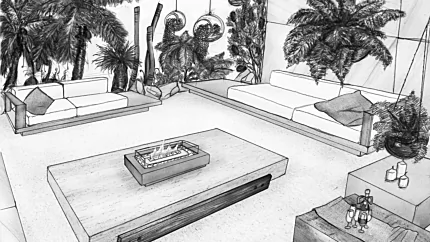
For multi-property rollouts, the EcoSmart Fire trade programme handles specification, sample co-ordination, and bespoke configuration as a single project workstream. Custom Pop-series finishes are matched to a brand colour palette; Flex openings can be sized to bespoke widths spanning 378 to 4,030 mm [14.9 to 158.7 in] across twelve standard configurations and bespoke briefs beyond that. One certified specification sheet covers USA, UK, Europe, and Australia in a single document, which is the difference between a portfolio rollout that ships on schedule and one that stalls at regional approvals.
The argument for moving now is straightforward. Every quarter a property defers the real-flame decision is a quarter of dwell time, F&B uplift, and guest-review sentiment going to the property next door that already installed it. The technology has caught up to the design ambition; the certifications cover every market the portfolio operates in; and the procurement path is the simplest it has ever been. The properties holding back are not protecting themselves from risk. They are leaving the warmest part of the room cold.