Loading image...

Flex 50SS Fireplace Insert
Most cost-benefit guides on fireplace inserts make a quiet assumption: that you already own a masonry chimney and you're choosing between a gas, wood, or pellet retrofit. That assumption rules out apartments, high-rise builds, heritage homes with sealed flues, and the growing share of renovations where adding a chimney is structurally impossible or financially absurd. So the honest answer to “are fireplace inserts worth it?” depends on which insert, in which home, doing which job.
This article works through five dimensions you can actually use to decide: upfront cost, installation economics, day-to-day running costs, heat output and efficiency, and the non-financial return on design freedom and resale value.
Loading image...
Flex 50SS Fireplace Insert
Buyers tend to ask “how much” before they ask “for what”, which is fair, but it leads to bad comparisons. A wood-burning insert at the bottom of its price band is not playing the same role as a designer-led bioethanol fireplace insert at the top of its band. The first is a hardware retrofit; the second is an architectural element. Both are called “inserts” and that’s where the confusion starts.
Across the category, four broad price tiers exist. At the entry level sit smaller traditional retrofits and compact electric inserts, where the unit cost is modest and the value sits in the heat. Mid-range covers larger electric inserts and our entry-tier bioethanol fireplace inserts: the Heritage range, for example, drops a UL 1370 certified ethanol burner into a traditional hearth aesthetic without any of the chimney work that price tier would normally imply. The premium tier covers our wider Flex range, with twelve opening sizes and three burner configurations, and shallower-depth electric inserts at 239 mm [9.4 in] of build depth for retrofitting flush into a thin wall. The top of the category is the multi-burner, multi-sided architectural install, where the insert is the room.
What you don’t get from any of those bands is a single number. Running costs, installation, and the surrounding finishing materials shift the total spend more than the unit cost itself. The next two sections matter more.
Bioethanol and electric fireplace inserts can reduce installation costs by up to 70% versus gas because they require no flue, no gas line, and no licensed electrician for the appliance itself. Installation typically completes in under an hour once the cavity is framed.
That’s the single number most buyer’s guides miss. Industry cost data from the home services marketplace Angi’s 2026 cost guide puts labour for a wood-burning insert at roughly eleven times the labour cost of an electric insert, and a gas insert at roughly seven and a half times. Why? Because traditional inserts pull in a flue liner, a gas fitter, a chimney sweep, building approvals where applicable, and often a structural engineer if the existing chimney needs rework. Each trade carries scheduling overhead. Each adds days, sometimes weeks, between purchase and first fire.
A zero-clearance bioethanol or electric insert removes most of that supply chain. Our ventless fireplace insert ranges install into wood or metal studs, partial or non-load-bearing walls, without flue, gas, or hardwired electrical infrastructure for the burner. The Frame range is engineered for retrofit into existing walls with minimal structural adjustment, which is why it gets specified into high-rise apartments where a gas line is a non-starter. The Heritage range drops directly into existing masonry openings, converting an unused traditional fireplace into a working clean-burn unit without touching the chimney.
The trade-off worth naming: installation savings shift the budget toward the unit and toward finishing materials. Drywall rated for the heat output, hearth tiling, surround joinery, and a fire extinguisher rated AB:E or ABC all sit on the buyer’s side of the line. They cost less than the trades a traditional retrofit displaces, but the line item shows up somewhere.
Installation step | Traditional gas or wood insert | Bioethanol or electric insert |
|---|---|---|
Flue or chimney work | Required (line, sweep, rework) | Not required |
Gas line | Required (licensed fitter) | Not required |
Hardwired power | Sometimes required | Plug-in for electric; none for bioethanol |
Trades involved | Three to five | One specialist |
Approvals | Often required | Generally none for the appliance |
Install time | Days to weeks | Under an hour once cavity is framed |
The running-cost picture splits cleanly by fuel. Our Motion electric range runs at roughly 2 cents per hour on flame-only LED operation and roughly 24 cents per hour with the full 1,500 W heater engaged, based on average US electricity pricing. Two cents per hour is less than most household lighting; 24 cents per hour is comparable to running a small space heater in a single room. The point isn’t the exact figure, which varies by tariff, but the order of magnitude. LED flame on its own is effectively free to run.
Bioethanol runs on e-NRG, our own bioethanol fuel, available in litres in Australia and the UK and in gallons and quarts across the US and Canada. The Heritage range burns for between seven and thirteen hours per fill depending on burner configuration, which is the running-cost benchmark that matters most to a homeowner: refilling on a Friday and still having flame on Saturday morning is a different lifestyle equation from a wood fire that demands attention every forty minutes.
Gas inserts carry both a consumption cost and, in most networks, a standing charge whether the unit runs or not. Wood inserts add ongoing supply (seasoned hardwood, kindling), ash disposal, and an annual chimney sweep. None of these are dealbreakers. They just need to sit in the cost-benefit calculation alongside the unit and install figures, not after them.
Fuel type | Hourly running cost framing | Ongoing inputs needed |
|---|---|---|
Bioethanol | Fuel only, per fill; long burn per refill | e-NRG bioethanol fuel |
Electric (flame only) | Pennies per hour | Electricity tariff |
Electric (with heater) | Comparable to a small space heater | Electricity tariff |
Gas | Consumption plus standing charge | Gas tariff, annual service |
Wood | Variable; wood supply driven | Wood, kindling, ash disposal, annual sweep |
This is where a fireplace insert pays back the rest of its cost. Open masonry fireplaces lose between 80 and 90% of their heat up the chimney, according to US EPA Burn Wise guidance from the US EPA Office of Air and Radiation. The whole point of putting an insert into that opening is to recover that loss.
Different fuel types recover the loss differently. A high-efficiency gas insert with sealed combustion can reach up to 85% efficiency, according to data from the Hearth, Patio & Barbecue Association. Bioethanol fireplace inserts with closed combustion behave differently again: there’s no flue, so there’s no path for heat to escape. Our Flex range claim is plain: every BTU stays in the room. Electric inserts convert nearly 100% of their electrical energy to heat at the unit level, although the upstream efficiency depends on the electricity grid feeding them.
Range | Heat output range | Room coverage |
|---|---|---|
Flex | 5,800 BTU/h (1.7 kW) to 45,870 BTU/h (13 kW, triple configuration) | Roughly 20 m² to 195 m² |
Frame | 11,430 BTU/h (3.3 kW) to 15,290 BTU/h (4.5 kW) | Roughly 40 m² to 65 m² |
The trust-protecting caveat is essential. Inserts in the bioethanol and electric category deliver their value as zone heating, not as a replacement for central heating. They warm the room they’re in well, they don’t pretend to warm the whole house, and the running-cost economics depend on that boundary being respected.
There’s a tangent here worth a sentence. A 2025 peer-reviewed study on bioethanol burner design by Ryšavý and colleagues, published in Applications in Energy and Combustion Science, found that single-chamber burners produce 11 to 31% higher average heat output than double-chamber designs. Burner geometry, not unit size, drives a real share of the heat-output difference between products in this category.
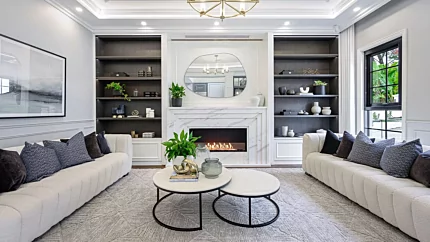
The cost-benefit case isn’t purely about kilowatts. The bigger story for many buyers is the room of placements a chimney-free insert unlocks. Apartments and high-rise units where a flue is structurally impossible. Renovations where a slab floor rules out underfloor gas. Heritage homes where the existing fireplace opening can be converted, not gutted. Spaces where a thin retrofit depth matters more than a deep gas firebox.
The Flex range exists in twelve opening sizes for that reason. The Frame range was engineered specifically for retrofit into existing walls with minimal structural adjustment. The VB2 retrofit burner is designed to drop into an existing Edwardian, Federation, Art Deco, or Art Nouveau fireplace opening, levelled with adjustable feet, without touching the surround. That is the kind of detail that turns a renovation from a six-figure question into a single-afternoon install.
On the resale side, the economics line up with the design freedom. According to AES Hearth and Patio, citing Redfin, homes with a fireplace list for around 13% more than the national median sale price. A 2016 Angi survey found that 70% of real estate agents and 77% of buyers agreed fireplaces add value. Our own ROI analysis puts built-in fireplaces at valuations 6 to 12% higher than comparable properties, with 23% faster average sale times. The resale premium isn’t automatic, though. It depends on the insert looking like part of the architecture, not bolted on as an afterthought, which is where a designer-grade insert beats a generic one.
Then there’s the lifestyle factor that doesn’t show up in any spreadsheet. Pre-lit ambience in under five minutes. No kindling. No smoke. No waiting twenty minutes for the room to warm. The decision to light a fire stops being a project and becomes a routine.
Fireplace inserts are worth the investment for homeowners who want a sealed, efficient heat source for a single room, particularly in chimney-free spaces where bioethanol or electric inserts eliminate the multi-trade installation cost of gas and wood alternatives.
Worth it if you have an unused traditional fireplace that’s leaking heat up the chimney, a chimney-free room or apartment where a flue isn’t an option, or a renovation underway where avoiding gas and chimney trades shortens the build by weeks.
Think twice if you’re looking for a primary heat source for a whole home (an insert in this category supplements central heating, it doesn’t replace it), or if you’re moving out within a year or two and the resale window won’t capture the value uplift.
Budget extras for: a fire extinguisher rated AB:E or ABC, a working smoke alarm in the same room, finishing materials rated to the heat output, and the fuel or electricity tariff that will run the unit. None of these are large line items, but they belong in the total.
The longer answer, with the model-by-model breakdown of our fireplace inserts collection, sits on the cluster pillar.