Loading image...

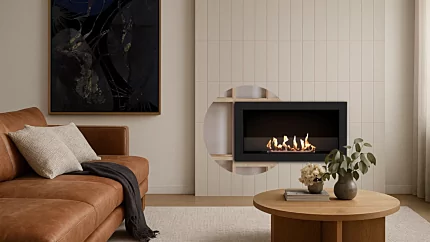
Frame Fireplace Inserts
If you have spent the last week reading fireplace insert guides, you have probably noticed every one of them tells the same story. Gas, electric, wood. Sometimes pellet. Pick one. The problem is that for a large slice of readers, none of those three solve the actual situation: the apartment with no chimney access, the renovation where the gas line will not reach, the architect’s wall that cannot host a flue, the homeowner who wants real flame without the soot.
That gap is the reason this article exists. The four real-world types of fireplace inserts on the market today are gas, electric, wood, and bioethanol, and the comparison only makes sense when all four sit on the same table. What follows walks each fuel type through heat output, venting, installation, cost tier, sustainability, and design. The goal is not to push a single category. It is to give you the frame the standard three-way comparison leaves out.
Loading image...
Frame Fireplace Inserts
A fireplace insert is a self-contained heating unit designed to fit inside a new wall cavity or an existing fireplace opening, sealing off the airflow loss of an open hearth and converting that cavity into an efficient heat source. Four fuel types dominate the modern market: gas, electric, wood, and bioethanol. The first three are familiar; the fourth tends to be missing from the conversation entirely, which is why most readers arrive at the comparison with three categories in mind instead of four.
Bioethanol belongs on the list for a simple reason. The category is certified to UL 1370 in North America, EN 16647 in Europe, and complies with ACCC requirements in Australia. It is sold globally, used in residential and hospitality projects from Manhattan apartments to Sydney rooftops, and it answers the one question every other category struggles with: what do you do when the building cannot host a flue? Pellet inserts also exist, but they sit outside the four mainstream categories for most readers and need either a dedicated vent path or a specialised feeding system. For our ventless fireplace inserts audience, the four-category frame is the one that maps cleanly onto real selection decisions.
The four fuel categories, at a glance:
Gas: natural gas or propane, sealed combustion, direct-vent or B-vent flue, high heat output, fixed infrastructure.
Electric: LED flame simulation with optional resistive heating element, no combustion, no venting.
Wood: solid fuel inside a sealed firebox with a steel liner up an existing masonry chimney.
Bioethanol: liquid plant-based fuel in a stainless steel burner, real flame, no flue, no gas line, no electrical hookup.
Gas inserts burn natural gas or propane inside a sealed combustion chamber, with intake air drawn from outside and exhaust expelled through a direct-vent or B-vent flue. The heat that reaches the room comes through the front glass and the surrounding metal body, and a sealed system means combustion gases never enter your living space. Heat output sits roughly between 20,000 BTU/hr (5.9 kW) and 40,000 BTU/hr (11.7 kW), making this the second most powerful category after wood. Thermostatic control is standard, remote ignition is common, and a smart thermostat integration is increasingly typical on premium units.
Where gas wins is consistency. Hit the switch, the flame is there, the room is warm in minutes, and the heat output can be modulated cleanly. Where gas constrains is everything around the unit. A gas line has to reach the firebox, which means a gas fitter, a permit, and depending on the property, a meaningful trench or wall chase. A vent path has to clear the exterior wall or roofline. Roughly 30% of the heat the unit generates is lost through the flue system, which means the BTU output on the spec sheet overstates what reaches the room.
The pros and cons in three each:
Pros: high heat output, thermostatic control, sealed combustion safety, fast ignition.
Cons: requires an existing or installable gas line, professional licensed installation, vent path to the exterior, fossil fuel source.
Gas insert installation must be carried out by a licensed gas fitter in every major market. The UL listing applies in North America, the EN and CE standards apply in Europe, and Australian Gas Association certification plus state-level licensing apply in Australia. This is not a DIY category and the warranty position on most products explicitly requires installation by a certified trade.
Loading image...

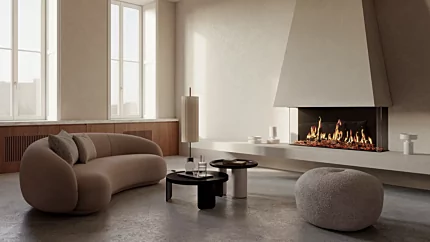
Motion 60BY Electric Fireplace
Electric inserts produce heat through a resistive element and simulate flame with LED projection. There is no combustion, no flue, no fuel storage, and no clearance distance dictated by combustion air. The unit either plugs into a standard outlet or hardwires to a dedicated circuit, and most premium models split the flame and the heater onto separate controls so the flame can run in summer without warming the room.
Heat output is the trade. Domestic circuits cap the available power, so electric inserts typically deliver 5,000 BTU/hr (1.5 kW) on a 120V circuit and up to 10,000 BTU/hr (3.0 kW) on a 240V circuit. That is enough to take the edge off a moderate room but not to act as primary heat for a large open plan. The flame is simulated, not real. For some readers that is a deal breaker; for others, the visual quality of a modern LED flame is close enough that the trade is worth it for the placement freedom it unlocks.
Within the electric fireplace inserts category, EcoSmart Fire's design-led tier sits well above the LED-strip products that dominate big-box retail. Our Switch series uses FX Technology to deliver adjustable flame patterns and accent colours across six sizes from 44 inches to 120 inches wide, rated for indoor and outdoor use under cover, with heat output up to 10,000 BTU/hr (3.0 kW) on 240V. Our Motion series uses Motion Picture Technology to produce a cinematic, multi-dimensional flame with realistic wood-crackling sound, indoor only, also spanning six sizes from 30 inches to 120 inches wide. Operating cost on the Motion series sits at roughly two cents per hour when running the flame alone and roughly 24 cents per hour with the heater engaged, calibrated to US average electricity pricing.
A short aside on visual quality. Electric flame technology has moved further in the past five years than in the previous twenty, and the difference between an entry-level LED-strip insert and a cinematic Motion Picture insert is genuinely large. If you have written off the category based on what electric fireplaces looked like in 2015, it is worth a second look before you decide.
Wood inserts solve a specific problem: an existing open masonry fireplace that loses more heat than it produces. The insert sits inside that opening as a sealed steel or cast-iron combustion box, vented up the existing chimney through a stainless steel liner, and converts what was a draughty hole in the wall into a high-efficiency heat source. EPA-certified models can reach 70% combustion efficiency, with peak output sitting between 30,000 BTU/hr (8.8 kW) and 80,000 BTU/hr (23.4 kW), which is the highest of any of the four categories.
What wood delivers that nothing else does is the real thing. Real flame with real crackle, real wood smell, real radiant warmth from a real combustion process. Heat is independent of the grid, which matters in rural areas and during outages. The fuel is renewable when responsibly sourced, and for readers in colder climates a wood insert can be the difference between heating the whole house and only the room with the unit.
The compromise is everything around that flame. You need an existing masonry chimney in sound condition, plus a stainless steel liner specified to the insert. Fuel is handled manually, ash is cleared regularly, and the chimney needs sweeping at least annually. Particulate emissions are real, and most urban jurisdictions now restrict new wood-burning installations under EPA standards in North America, Ecodesign requirements in the UK and EU, and AS/NZS 4012-2014 in Australia. According to the EPA's Burn Wise program, open fireplaces create roughly 20 times the air pollution of EPA-certified wood heaters, and EPA-certified inserts use one-third less wood for the same heat. The American Lung Association notes that 65% of the woodstoves in use in the US are older, inefficient devices, which is part of the reason newer certified inserts and changeout programs have become a regulatory focus.
The pros and cons:
Pros: real flame and crackle, renewable fuel, grid-independent, highest peak heat output of any category.
Cons: requires existing masonry chimney plus liner, manual fuel handling and ash removal, regular chimney sweeping, particulate emissions, regulatory restrictions in urban areas.
Most readers who end up with a wood insert inherit one, in the sense that they bought a house with an existing masonry chimney and decided to upgrade rather than abandon it. As a fresh-build choice in a new-construction context, the category is the least common of the four.
Loading image...

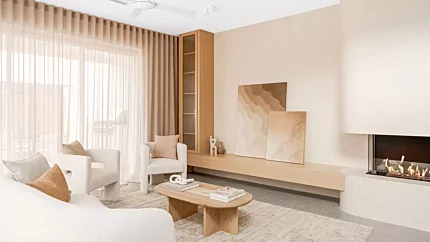
Flex 32LC
If you have narrowed your search to gas, electric, and wood, you have been working from a market picture that quietly leaves out a fourth category. Bioethanol inserts solve the exact problems the other three surface. No chimney access? Bioethanol does not need one. Cannot run a gas line to the wall you want the fire on? Bioethanol does not need one. Want a real flame but cannot live with the soot, smoke, or maintenance of wood? Bioethanol gives you real flame with none of that.
The mechanism is straightforward. A sealed stainless steel burner holds liquid bioethanol fuel. The fuel is lit by hand or by remote ignition depending on the burner, and closed combustion produces real flame, water vapour, and a small amount of carbon dioxide. There is no smoke, no soot, no ash, no flue. The unit needs no gas line, no chimney, and no electrical hookup. Zero-clearance construction means the unit can be framed into wood or metal studs in almost any wall, indoor or outdoor under cover. For apartments, mid-floor units, and renovations where structural flue work is prohibited, bioethanol is one of only two categories that can be installed at all.
Three bioethanol fireplace inserts ranges anchor the EcoSmart Fire offering, each shaped around a different installation scenario.
Our Flex series is the new-build and retrofit workhorse. Twelve widths span 18 inches through 158 inches, and four viewing configurations cover single-sided, double-sided see-through, corner, and box installations. Heat output reaches 15,000 BTU/hr (4.4 kW) with the XL900 burner across an all-flame configuration, with a 2.4 gallon (9 litre) fuel capacity and an 8 to 13 hour burn time. The Flex 50SS at 57.9 inches wide is the mid-range flagship; the Flex 42LC corner produces 13,650 BTU/hr (4.0 kW) with a 1.8 gallon (6.8 litre) capacity and 9 to 12 hours of burn; the Flex 50DB see-through configuration delivers flame visible from both sides of a room-divider wall.
Our Frame series is the retrofit-friendly option for existing walls. The unit drops into a wall cavity with minimal structural adjustment, delivering 15,000 BTU/hr (4.4 kW) with the XL900 burner across heating coverage of roughly 60 square metres (646 square feet). Apartment specification is the defining use case here because the installation needs no gas, no flue, and no certified trade beyond standard wall framing.
Our Heritage series is for readers with an existing masonry fireplace opening they no longer want to use for wood. Three sizes drop directly into traditional openings. The Heritage 26SS at 33.9 inches wide produces 13,000 BTU/hr (3.8 kW). The Heritage 42SS at 49.9 inches wide produces 13,000 BTU/hr (3.8 kW) with a 1.3 gallon (5 litre) BK5 burner and a 7 to 11 hour burn time. The Heritage 56SS at 63.9 inches wide produces 15,000 BTU/hr (4.4 kW) with the XL900 burner, a 2.4 gallon (9 litre) capacity, and an 8 to 13 hour burn. The grate aesthetic mimics a traditional wood or gas insert but with none of the chimney work.
All three ranges are certified to UL 1370 in North America, EN 16647 in Europe and the UK through BSI, and comply with ACCC requirements in Australia. Two honest constraints to flag. Bioethanol inserts are supplemental heat, not primary heat, and minimum room volumes apply: the Heritage 26SS at 13,000 BTU/hr needs roughly 2,472 cubic feet (70 cubic metres), and the Flex 50SS at 15,000 BTU/hr needs roughly 3,885 cubic feet (110 cubic metres). And while the inserts ship globally, our e-NRG bioethanol fuel is not stocked in the EU; readers there source fuel locally from non-affiliated suppliers.
The table below pulls the four categories onto one frame. Heat output ranges reflect typical category averages rather than peak engineering claims, and the venting and installation rows describe what the average installation actually requires.
Criterion | Gas | Electric | Wood | Bioethanol |
|---|---|---|---|---|
Heat output (typical) | 20,000 to 40,000 BTU/hr (5.9 to 11.7 kW) | 5,000 to 10,000 BTU/hr (1.5 to 3.0 kW) | 30,000 to 80,000 BTU/hr (8.8 to 23.4 kW) | 13,000 to 15,000 BTU/hr (3.8 to 4.4 kW) |
Heat retention in room | ~70% (30% lost to flue) | ~100% (all input becomes heat) | 60 to 75% (EPA-certified) | ~100% (closed combustion, no flue) |
Venting / flue required | Yes (direct-vent or B-vent) | None | Yes (chimney plus liner) | None |
Installation complexity | High; licensed gas fitter, vent path | Low; plug-in or hardwired | High; chimney inspection, liner, certified installer | Low to medium; DIY-suitable framing for most models |
Cost tier | Premium (unit plus gas line plus venting) | Entry-level to mid-range | Mid-range to premium (unit plus liner plus sweeping) | Mid-range to premium (no infrastructure cost) |
Sustainability | Fossil fuel; flue heat loss | Depends on grid mix | Renewable if responsibly sourced; particulate emissions | Renewable plant-based fuel; CO2 equivalent to plant growth cycle |
Best suited for | Homes with existing gas line and vent path | Apartments, supplemental warmth, design-first interiors | Rural and semi-rural homes with existing masonry chimney | Apartments, renovations, design-led new-builds, outdoor-covered settings |
If venting and structural infrastructure dictate the answer, bioethanol and electric are the only two categories that survive every constraint. The question between them is whether the flame needs to be real.
Most fireplace insert guides treat the firebox as a fuel container. For anyone designing the room around the fire, that framing misses the point. The fuel type does not just dictate heat output; it dictates which design configurations are physically possible. A double-sided fireplace cannot exist where a flue takes up the back wall. A corner installation cannot exist where the burn chamber needs a chimney directly above it.
Gas inserts are almost exclusively single-sided in residential direct-vent products, because the sealed glass front and the vent geometry behind the unit cannot be reorganised around an open side. Wood inserts are single-sided by necessity; the firebox shape is dictated by the chimney path. Electric inserts have the most absolute design freedom of any combustion-free category because there is no combustion clearance to respect, no vent to plan around, and no fuel storage to accommodate. The flame is simulated, which is the trade. Within our modern fireplace inserts range, Motion Picture Technology and FX Technology bring the flame closer to real than the standard LED category, but the underlying technology is still projection rather than combustion.
Bioethanol delivers the broadest viewing flexibility of any real-flame option. Single-sided, double-sided see-through (room-divider), corner, and rotational configurations are all certified and available, because closed-combustion burners can be viewed from multiple angles without flue draft loss. Our Flex 42LC sits in a corner where neither gas nor wood could be installed. Our Flex 50DB lets flame face two rooms across a divider wall. Our Heritage 56SS gives the traditional hearth aesthetic in a contemporary build where the chimney has been decommissioned. The four configurations and the fuel types that support each:
Single-sided: every category supports this; the default firebox.
Double-sided see-through: electric and bioethanol only, as room dividers between two living spaces.
Corner: electric and bioethanol; gas and wood are constrained by vent geometry.
Three-sided / peninsula: electric (simulated) and bioethanol (Flex configurations) only.
Selection rarely starts with fuel. It starts with a constraint. Below are five reader situations and the fuel category each one points to. Where one of our ranges fits, we say so; where another manufacturer's category is the honest answer, we say that too.
You have an existing masonry fireplace and chimney you want to keep using. If you want real wood fire and the chimney is in sound condition, a certified wood insert is the natural choice. If the chimney is decommissioned or you want a clean modern aesthetic without the re-lining and sweeping commitment, our Heritage series drops into the same opening and gives you real flame without the maintenance.
You have an existing gas line and want simple thermostatic warmth. A direct-vent gas insert from an established manufacturer is the most efficient path. This is the scenario where gas is genuinely the right answer; the infrastructure already exists, the fuel is on tap, and thermostatic control delivers exactly what you want.
You live in an apartment, high-rise, or renovation with no chimney access. Bioethanol and electric are the only two categories that can be installed at all. Our Frame or Flex bioethanol inserts deliver real flame in this scenario; our Motion or Switch electric inserts deliver simulated flame at lower running cost when not heating. Both bypass the structural blockers that rule out wood and gas.
You want real flame but no flue, no gas line, and the design freedom to mount it anywhere. Bioethanol is the only category that meets all three constraints. The Flex range gives you single-sided, double-sided, corner, or see-through configurations on the same fuel type, with installation in framed walls of new builds or retrofit projects.
You want a supplemental focal point with the lowest operating cost and complete trans-seasonal flexibility. Electric wins on running cost when the flame runs without the heater. Our Switch series is rated for covered outdoor patios; our Motion series sits indoors with cinematic flame quality. The flame-only mode lets the unit run year-round as a visual feature without warming a room you do not want warmed.
Combustion appliances are a regulated category for good reason, and the certification a manufacturer can show is the cleanest single signal of how seriously they take the engineering. Six questions to put to any supplier before you commit:
Is the unit certified to UL 1370 in North America, EN 16647 in Europe and the UK, or does it comply with ACCC requirements in Australia? Bioethanol and electric inserts should hold the regional certification that applies to your market.
What is the certified BTU output, and what is the minimum room volume required to operate the unit safely? For bioethanol, this is the most important spec after heat output, and it should be on the data sheet.
Does installation require a licensed trade, such as a gas fitter or electrician, or is the unit DIY-suitable? Gas always requires a certified installer; bioethanol and most electric inserts do not.
Is the unit rated for indoor only, outdoor under cover, or both? Outdoor exposure without overhead cover voids most warranties.
What clearance distance from combustible materials is specified? Our bioethanol inserts require a minimum 36 inch (914 mm) clearance from combustibles, which sets the framing geometry around the unit.
What is the warranty position on outdoor exposure, third-party fuel, and DIY installation? Read this before purchase, not after.
Wood inserts produce the highest peak output, typically between 30,000 BTU/hr (8.8 kW) and 80,000 BTU/hr (23.4 kW), followed by gas at 20,000 to 40,000 BTU/hr (5.9 to 11.7 kW), bioethanol at 13,000 to 15,000 BTU/hr (3.8 to 4.4 kW), and electric at 5,000 to 10,000 BTU/hr (1.5 to 3.0 kW). Heat in the room depends on retention as much as output, so closed-combustion bioethanol and electric lose nothing to flues while gas and wood lose 25 to 40% through venting.
Yes. Both bioethanol and electric inserts are completely vent-free and can be installed in buildings with no chimney, including apartments and mid-floor units. They are the only two categories that meet that condition; gas and wood both require a vent path to the exterior.
Electric inserts have the lowest flame-only operating cost, sitting at roughly two cents per hour on our Motion series with the heater off. Running cost rises sharply when the integrated heater is engaged, to around 24 cents per hour on US average electricity. Bioethanol fuel cost depends on burn time and frequency; gas and wood cost depends on regional fuel pricing.
They produce real heat, up to 15,000 BTU/hr (4.4 kW) on the Flex 50SS and Heritage 56SS, but we rate them as supplemental rather than primary heating. The honest position is that they take the edge off a room rather than heating a whole house, and minimum room volumes apply for safe operation.
Only specific products in the electric and bioethanol categories. Our Switch electric series is rated for covered outdoor patios. Several of our bioethanol units, including selected Flex and Heritage configurations, run outdoors under a protective overhang. Direct exposure to rain, snow, or sustained wind voids most warranties regardless of category.
Before you started this article, the comparison was probably gas, electric, and wood, in some order, weighing infrastructure against atmosphere against running cost. After it, the comparison is four categories instead of three, and the fourth changes which constraints actually rule the decision. For some readers, wood remains the right answer. For others, gas. For more readers than the standard three-way comparison suggests, the answer is bioethanol or electric, because those are the only two categories that work at all when the building cannot host a flue.
The next step is matching the category to your home. If your search has led you to the bioethanol or electric side of the table, our fireplace insert range covers Flex, Frame, Heritage, Switch, and Motion across every viewing configuration and almost every installation context. If your search has led you elsewhere, that is the right outcome too; the article's job was the frame, not the sale.