Loading image...


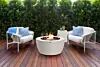
Mimosa 40 Fire Table
"Weather-resistant" is the most overused phrase in outdoor fireplace marketing, and one of the least defined. Walk through any showroom or scroll any product page and you will find the same vague reassurance applied to wildly different builds, with nothing behind it to verify. A weather-resistant outdoor ethanol fireplace is built from materials that withstand UV, rain, thermal cycling, and (where relevant) salt corrosion, and arrives with an accessory system designed to protect it between burns. Whether a given unit lives up to that depends on details most brochures skip.
Weather is not one thing. It is UV that fades polymers and dulls finishes; it is rain and condensation that find their way into fuel reservoirs; it is wind that wrestles with an open flame; it is salt-laden air at the coast and chlorine spray by the pool; it is hail and frost in winter and the slow grind of seasons in between. For homeowners committing to a permanent outdoor installation, and for designers writing the schedule, the right question is not "is this weatherproof?" but "what specifically protects it from what?"
This guide works through six evaluation criteria, plus a year-round-use bracket and a closing checklist. Readers still weighing whether outdoor is the right context at all should start with our indoor vs. outdoor ethanol fireplaces comparison; everyone else, read on.
Loading image...
Mimosa 40 Fire Table
A weather-resistant outdoor ethanol fireplace is one built from materials that withstand UV exposure, rain, temperature swings, and (where relevant) salt corrosion, with a burner certified for outdoor use and an accessory system that protects the fuel reservoir from moisture between burns. No formal IP rating governs the category the way one governs electronics, so durability is judged by material specification, certifications, and the protective accessories supplied with the unit.
Four stressors do most of the damage, and a credible outdoor unit accounts for all four:
Stressor | What it does | What to check for |
|---|---|---|
UV | Fades polymers, dulls finishes, embrittles seals | UV-resistant materials, UV-coated covers |
Water | Dilutes ethanol in the reservoir, corrodes fasteners, pools on flat surfaces | Sealed concrete, Grade 304 stainless, anti-pooling cover design |
Thermal cycling | Cracks porous materials, stresses joints | Composite or marine-grade substrate, expansion-tolerant build |
Salt and chlorine | Pits stainless steel, degrades coatings | Wash-down protocol, ceramic-coated burner, sheltered siting |
Loading image...


Loading image...


Most of the spec sheet lives in the material list. Each of the materials below earns its outdoor classification differently, and each carries a maintenance trade-off worth knowing before the unit arrives on a delivery pallet.
Fluid™ Concrete is the proprietary composite that surrounds most of our outdoor fire tables and fire pits, a green-cement-and-recycled-aggregate blend developed for outdoor work. It resists UV, stains, impact, mould, and mildew, and tolerates the thermal cycling that splits porous concrete in winter. The maintenance reality is a penetrating sealer applied every six months for residential installations, every three months for commercial. A clear-coat car polish on top is optional for an additional water and UV barrier, and is the move for owners who treat the unit as a long-term fixture rather than a season’s experiment. Best for: most residential and commercial outdoor sites, including coastal locations when the sealer schedule is kept.
Grade 304 stainless steel is the default burner-body grade across our outdoor burners. Corrosion-resistant in most environments, it is genuinely robust on a sheltered patio. The compromise sits in saline and chlorinated environments: according to Reliance Foundry’s 2025 materials guide, Grade 304 can begin to suffer localised pitting in saline environments containing as little as 25 ppm of sodium chloride. That figure does not write 304 off for coastal use; it means coastal owners need a wash-down routine, and the optional Black Ceramic Coating on the burner adds a sacrificial protective layer that meaningfully extends finish life. Best for: most residential outdoor sites; coastal and pool-adjacent installations with maintenance discipline.
Grade A teak is the warm-handed option. Used across several of our outdoor fire tables, it carries 5 to 7% natural oil in the heartwood and is the same material shipbuilders have been trusting for two thousand years. Left unoiled, teak silvers to a soft grey patina that stabilises after roughly five years; oiled annually, it holds its warmer tone. A quick aside worth noting: that silvering is often mistaken for damage, but it is the wood quietly doing its job. The natural silica and rubber oils stay where they are, the structure is unaffected, and the patina is purely cosmetic. Best for: owners who want a living surface that ages gracefully without anxious maintenance.
Toughened and borosilicate glass appears on windscreens, fire screens, and surrounds. Borosilicate’s low coefficient of thermal expansion lets it shrug off the temperature differential between an active flame and a sudden cold rain, which is the realistic scenario for an outdoor unit caught by a passing shower mid-burn. Tempered safety glass plays the same role on most of our windscreens. Best for: flame-facing surfaces and wind protection on open burners.
Powder-coated finishes sit on top of stainless and steel substrates on a handful of accessories and structures. They are durable on patios, but worth an annual visual inspection. A chip that exposes the substrate is the start of a longer story, and catching it early means a touch-up instead of a replacement.
Outdoor ethanol fireplaces require greater overhead clearance than indoor models, typically 2,000 mm above the flame for open burners without a firebox, compared to 1,500 mm indoors. Side clearance to combustibles stays at 1,500 mm in all directions, with a minimum 600 mm to fixed furniture. The reason for the larger overhead figure is partly counterintuitive: less radiant heat is reflected back from walls and ceilings in an open setting, so manufacturers specify wider zones to absorb wind-driven flame deflection and seasonal foliage growth.
Direction | Indoor | Outdoor (open burner, no firebox) |
|---|---|---|
Overhead | 1,500 mm | 2,000 mm |
Combustibles (all sides) | 1,500 mm | 1,500 mm |
Fixed furniture (sides) | 600 mm | 600 mm |
Wind-moveable items deserve their own buffer. Curtains, shade sails, umbrellas, low branches, even potted plants near the unit, anything that can swing into the flame zone, needs a positional allowance beyond the published clearance. ESF’s brand guidance specifies a 1,650 mm minimum to moveable combustibles, which is the safer number to design around. There is also a foot-traffic zone of approximately 1 m in front of the fireplace to consider when laying out seating and paths.
Covered patios sit at the awkward boundary between indoor and outdoor. A roof overhead does not turn an outdoor fireplace into an indoor one; the open sides still ventilate the unit, and the outdoor clearances continue to apply. Deck installations need a non-combustible base under the unit (stone, concrete, or pavers, not grass or artificial turf) and a minimum 12.5 mm air gap from the deck surface via articulating feet. Where the install touches structural elements such as a deck, a pergola, or a non-combustible base assembly, the ethanol burners range publishes the relevant clearances for each model, and they should be read against local code before the unit goes in.
Loading image...

Wind is the single most disruptive outdoor variable, and the way a unit handles it is what separates a true outdoor design from an indoor model placed outside. Open-flame ethanol with no flue has nothing to brace against a breeze; even a gentle gust can lift, lean, or extinguish the flame, and the resulting flame instability accelerates fuel consumption and leaves soot deposits where there should be none. LabTest Certification’s outdoor appliance research confirms that wind alters the fuel-air ratio in outdoor fire appliances, which is why certification testing under ANSI Z21.97 verifies safe operation across varied airflow conditions.
Four engineering levers manage wind on an outdoor ethanol unit:
Glass windscreens or fire screens sit around the flame and stabilise it in breeze. They depend on a 40 mm air gap below the glass edge so the burner can draw oxygen; without that gap, the flame starves and combustion runs incomplete. The 40 mm rule is the difference between a working outdoor fire screen and a smothered one, and it is worth checking the gap on any unit that ships with screens already installed.
Static windscreens for open fireboxes (built-in or custom installations) sit at the back wall of the firebox, 180 to 225 mm high and the full firebox width. This is the minimum spec for any open-firebox configuration and a non-negotiable for windy sites.
Burner orientation matters. Our outdoor burners are certified for the straight-back configuration. Angling or tilting the burner back may look fine on a render, but it destabilises the flame in airflow and is not a certified setting.
XL Baffles are available across the burner range as a specifier-grade option for regulating flame in outdoor environments. They are not standard equipment; they are the considered upgrade where wind is a known variable.
Siting earns the rest of the result. A unit tucked into a corner with a single wall on the prevailing-wind side performs differently from a unit in the middle of an open lawn. A planter, a hedge, a 600 mm low wall on one side: any of these breaks the wind enough to extend usable burn time, especially with the XS340 burner, which is the burner specified to operate across the broadest range of outdoor conditions in our outdoor lineup.
Loading image...


Rain or condensation in the fuel reservoir dilutes bioethanol and prevents ignition. It is the most common outdoor service complaint, and it is almost always a maintenance issue, not a product defect. The fix is straightforward: drain, clean, dry, and refill to restore ignition. The symptom is recognisable: a sputter, a refusal to light, fuel that smells faintly watery. None of it indicates a damaged burner; it indicates a burner that needs to be dried out.
Avoiding the failure mode comes down to a two-cover discipline. A Silicone Burner Cover sits over the fuel chamber whenever the unit is not in use, including between two burns on the same evening if rain is in the forecast. An All-Season Cover goes over the whole unit for longer breaks. Crucially, the unit must be completely dry before the cover goes on. Trapped moisture under a cover does more damage faster than no cover at all, because the cover stops the surface from drying naturally between cycles.
The cover-and-dry protocol in four steps:
After the burn, let the unit cool completely.
Wipe down any visible moisture or condensation on the surround and the burner.
Confirm the burner reservoir is dry, then fit the Silicone Burner Cover.
Once the surround is dry, fit the All-Season Cover over the whole unit.
The cover system itself is engineered around the failure mode. Our All-Season Covers use a 600D Oxford fabric, UV-coated, with mould-resistant stitching and a proprietary PVC anti-pooling cone that sheds water rather than collects it. Heavy-rain climates are the test case here: a flat-topped cover sits in a puddle, and that puddle eventually wins. The cone-and-shed design avoids it. Elastic cord closures hold the cover against wind, which matters more than buyers expect on the second night of a storm. For owners using e-NRG bioethanol (sold in litres across AU and the UK, and in gallons and quarts across the US and Canada, with the EU sourcing compatible fuel locally), the formulation is engineered for clean combustion but cannot tolerate water contamination, which is exactly why the cover discipline matters.
Loading image...

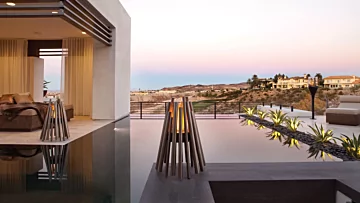
Salt and chlorine are the most aggressive variables in this category. Airborne salt deposits draw moisture and create localised pitting on Grade 304 stainless; pool chlorine in splash range accelerates the same process. FEMA Technical Bulletin 8 identifies a corrosion risk zone extending 300 to 3,000 feet (roughly 91 to 914 m) from the ocean, where annual inspection of metal components is a minimum precaution and more frequent attention is wise on any unit that lives outdoors year-round.
Three habits keep a coastal or pool-adjacent install in good order:
Rinse all exposed metal with fresh water on a regular cycle, weekly in coastal exposure, after every pool party in chlorinated splash range.
Inspect metal components every six months for early signs of pitting or finish degradation.
Maintain the sealer cycle on concrete and the oiling cycle on teak, both at the tighter end of the maintenance range in harsh sites.
Material selection should bend toward the environment. Fluid Concrete with a maintained sealer outperforms exposed stainless in salt-heavy locations, which is why our Fluid Concrete-bodied outdoor fire pits and fire tables suit coastal sites better than the all-stainless options. The Stix range is the exception worth flagging: it is all stainless steel and looks superb in coastal architectural projects, but it asks for the most disciplined wash-down routine in the lineup. For sites where chlorine and salt are unavoidable, the optional Black Ceramic Coating on burners adds a meaningful sacrificial layer, and the Grade A teak surrounds silver gracefully and structurally tolerate salt better than oiled timbers do. A partial windbreak (a low wall, a planter run, a screen on the seaward side) intercepts salt-laden wind and extends finish life across the entire assembly.
The Burner Lid earns its place here. Always fit it when the unit is not in use, and especially in coastal or pool-side sites where overnight humidity and airborne salt do their work quietly.
Weather resistance is not a single material claim. It is the unit plus its accessory kit, working as a system. A high-spec burner left exposed will degrade; a modest burner with a complete cover system will outlast it by a wide margin. Reframing the buying decision this way is the difference between paying for the product and paying for the protection.
Four accessory families form the protection layer:
Accessory | What it protects against | When to use |
|---|---|---|
All-Season Cover | Rain, snow, hail, UV, dust, wind-borne debris | Whole-unit protection between burns, especially overnight and during storms |
Silicone Burner Cover | Rain and condensation in the fuel chamber | Over the burner whenever the unit is not in active use |
Glass Windscreen / Fire Screen | Wind-driven flame instability, soot, fuel-waste | Standard on outdoor models; specify on open-burner installs |
Cover Plate (glass or solid) | Burner exposure when unlit; converts opening to flat surface | Between burns; useful for fire tables doubling as dining surfaces |
Our fireplace accessories line carries each of these, sold alongside the units they protect rather than as a standalone category. Covers and screens are model-specific, which is the most common spec error in this whole category, so check compatibility before the purchase order goes in, not after.
The short answer: outdoor-rated units in our range can stay outside year-round when they are properly covered, dry, and serviced. The longer answer depends on climate, and the climate brackets sort cleanly:
Mild temperate (most Australian coastal cities, much of the UK south coast, southern Europe): year-round outside with the full cover system in place is fine. Sealer and oiling cycles run on the standard schedule.
Cold winter and heavy snow (UK north, US northeast, alpine AU): the surround stays outside under the All-Season Cover; the burner unit benefits from an all-season bag during the deepest months. Bring the burner indoors if the unit will not be used at all between, say, December and March.
Tropical and monsoon: cover discipline is non-negotiable, and the sealer schedule moves to the tighter end of the range, three months residential rather than six.
For a complete outdoor comfort layer, an ethanol fireplace handles atmosphere and a Heatscope radiant infrared heater handles ambient warmth, with the two working in different registers and on different timescales. That pairing is worth a thought when the patio scheme is still on the drawing board.
Take this list to any showroom or supplier, and the marketing language stops being able to hide behind the word “weatherproof”:
Surround material is specified for UV, stain, and impact (Fluid Concrete, Grade A teak, or a comparable composite).
Burner body is Grade 304 stainless steel minimum, with a ceramic-coating option for harsh environments.
Certifications are stated clearly: UL 1370 listed (NA), EN 16647 BSI Certified (EU/UK), complies with ACCC standards (AU).
Outdoor clearances are published: 2,000 mm overhead, 1,500 mm to combustibles, 600 mm to fixed furniture, 1,650 mm to moveable combustibles.
Wind-management features are documented: glass windscreen, static windscreen for open fireboxes, or baffle availability.
A cover system is available or included: All-Season Cover with anti-pooling design and a Silicone Burner Cover.
Reservoir protection is specified: a Burner Lid or Cover Plate for between-burn protection.
Coastal compatibility is documented: wash-down protocol stated, ceramic coating optional.
Maintenance schedule is published: sealer cycle for concrete, oiling cycle for teak.
The accessory ecosystem is complete: screens, covers, and lids all available from the same brand and matched to the model.
A unit that ticks all ten is a genuine outdoor specification. A unit that ticks six is a vague claim with a price tag.