Loading image...
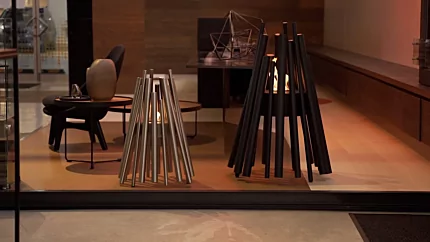
Stix Fire Pit Series
Most online guidance about indoor fire pit ventilation is written for a different fuel. Search the topic and you will find page after page on chimney sizing for gas, draft calculations for wood, and carbon monoxide alarms. None of which apply if your indoor fire pit burns bioethanol. The chemistry is different, the rule set is different, and the standards that govern it have names competitors rarely mention by name. This is the practical, specification-led version of what indoor ventilation actually requires.
Loading image...
Stix Fire Pit Series
A bioethanol indoor fire pit needs ventilation, but not the kind most people imagine. There is no flue, no chimney, and no carbon monoxide alarm requirement. What it does need is a room large enough for the burner, the clearances specified by the certification body, the accessories the standard mandates, and a hard, non-combustible surface beneath the appliance. For the EcoSmart Fire range, that translates to a minimum room volume of 40 m³ for the smallest indoor model and 116 m³ for the larger ones.
The reason is chemistry, not combustion gases in the usual sense. Bioethanol burns to carbon dioxide and water vapour at greater than 90 percent efficiency, with no carbon monoxide produced under complete combustion. The combustion equation is straightforward: C₂H₅OH + 3 O₂ → 2 CO₂ + 3 H₂O. The risk profile is not gas pooling or CO build-up, but air dilution. A small sealed room burning a 6 kW (20,433 BTU/hr) flame will gradually deplete oxygen and accumulate CO₂ until the flame itself starts to falter. Adequate room volume solves that problem upstream, which is why the standards body chose volume rather than mechanical extraction as the lever.
That logic is codified in three compliance frameworks: UL 1370 (North America), EN 16647 (Europe and the UK), and the ACCC Consumer Goods Safety Standard (Australia), which is the mandatory standard any device must meet to be legally sold in Australia. Only four bioethanol models in our indoor fire pits range carry that certification stack, and the rules below apply specifically to those. Anything else, including any gas variant or any outdoor-only model, never goes indoors regardless of how good the room ventilation looks.
UL 1370 sets the rule that every indoor bioethanol appliance has to satisfy: 5.7 m³ (200 ft³) of room air per 1,000 BTU/hr of burner output. The math is not negotiable. The burner's rated output, multiplied by 5.7 and divided by 1,000, gives you the minimum room volume in cubic metres. Anything smaller and the appliance is not legally compliant in UL-listing jurisdictions, even before you start thinking about clearances.
Two thresholds emerge for our indoor-rated lineup:
Burner | Heat output | Minimum room volume |
|---|---|---|
AB3 | 5,800 BTU/hr (1.7 kW) | 40 m³ [1,413 ft³] |
AB8 | 20,433 BTU/hr (6 kW) | 116 m³ [4,097 ft³] |
To make those numbers tangible, 40 m³ is roughly a 4 m by 4 m room with a 2.5 m ceiling, which fits the footprint of a typical lounge or studio living space. 116 m³ is the territory of an open-plan kitchen, dining, and living area in a contemporary home. If the room is borderline, the standards allow a fallback: a permanently open window of at least 25.4 mm, or a doorway connecting to a larger adjacent room. Note "permanently open." A window you intend to close mid-use does not count, and neither does an extractor fan, which moves air but cannot substitute for raw volume.
One exclusion sits outside the volume math entirely. Bathrooms are off limits for indoor fire pits regardless of how cavernous they happen to be. Two reasons: a sealed door breaks the adjacent-room fallback, and the presence of aerosolised body products, hair, and combustible fabrics within the splash zone of a flame raises the risk profile beyond what the certification accounts for.
The volume rule is also the reason cathedral-ceiling rooms make better candidates than typical apartment lounges. Doubling ceiling height effectively doubles the available volume without changing the floor plan, which is often the difference between an AB3-rated room and an AB8-rated one.
Room volume gets the oxygen right. Clearances keep the flame at arm's length from anything it could damage or ignite. Four numbers cover the entire installation envelope, and product spec sheets quote them as minimums rather than recommendations.
Direction | Surface or material | Minimum clearance |
|---|---|---|
Overhead | Ceilings, moveable objects | 1,500 mm [59.1 in] |
Lateral | Timber, plasterboard, joinery | 600 mm [23.6 in] |
Lateral | Curtains, upholstery, paper | 1,500 mm [59.1 in] |
Floor | Air gap beneath appliance feet | 12.5 mm |
The curtain figure is the one most people get wrong. It is not just radiant heat. A bioethanol flame draws its own convective current upwards from the burner, which creates a low-pressure zone that will pull a light fabric toward the flame if the curtain is close enough. The 1,500 mm rule accounts for that draft-driven ignition risk, which is why upholstery and paper get the same treatment even though their radiant-heat tolerance is higher. Some product pages will quote the overhead clearance as 2,000 mm rather than 1,500 mm; where the ceiling allows, take the higher figure, particularly in rooms where moveable lighting, fans, or hanging art might end up directly above the appliance.
The 12.5 mm floor gap looks trivial but is doing real work. Articulating feet on the underside of the appliance lift the body off the floor by that margin, allowing convective cooling beneath the burner and preventing heat transfer into the surface below. If you sit the appliance flush, the feet can no longer cool it, and the surface beneath will see a much higher operating temperature than the spec anticipates.
Ventilation buys you safe air. It does not buy you a safe surface, and the two are independent problems. The appliance must sit on a hard, level, non-combustible base. Stainless steel, concrete, brick, and natural stone all qualify. Carpet, grass, artificial turf, and indoor timber decking do not, and no quantity of room air changes the answer. Block the 12.5 mm floor air gap with a rug, a non-supplied tray, or a recessed installation, and the appliance is operating outside its certification regardless of how generous the rest of the room looks.
The Pod-series indoor configuration adds two mandatory accessories under EN 16647:
Indoor Safety Tray: one per burner. Catches any fuel spillage during refuelling and dampens heat transfer to the surface beneath.
AB8 Burner Efficiency Ring: required whenever the AB8 burner is installed in a Pod 30 or Pod 40 indoors. Without it the burner geometry no longer meets the certified emissions profile.
Omit either and you have voided EN 16647 compliance, which also voids the warranty. The same logic applies under UL 1370 and ACCC. The certification is not the appliance alone; it is the appliance, the specified burner, the indoor accessories, and the fuel type tested as a single system. Swap any one element and the test result no longer applies.
Australia layers an additional requirement on top. The ACCC Consumer Goods (Decorative Alcohol Fuelled Devices) Safety Standard 2017 requires freestanding ethanol fireplaces to have a dry weight of at least 8 kg and a footprint of at least 900 cm².
A practical pre-ignition walkthrough, in order:
Confirm the model is indoor-rated and burns bioethanol only. No gas variants indoors.
Confirm room volume: at least 40 m³ for an AB3 burner, at least 116 m³ for an AB8. If borderline, open a window by at least 25.4 mm or leave a doorway into a larger adjacent room, and keep them open throughout use.
Confirm the room is not a bathroom or any other small sealed space.
Confirm clearances: overhead ≥ 1,500 mm, lateral to combustibles ≥ 600 mm, lateral to curtains and fabrics ≥ 1,500 mm.
Confirm the surface is hard, level, and non-combustible, and that the 12.5 mm floor air gap under the feet is unobstructed.
Confirm the Indoor Safety Tray is fitted on compatible models. If using a Pod 30 or Pod 40, confirm the AB8 Burner Efficiency Ring is in place.
Store bioethanol fuel outside the room until the moment of refuelling, and read the ignition and extinguishing instructions before the first light.
A note for commercial and hospitality installations: local fire codes, lease conditions, and building-management ventilation standards often layer additional requirements on top of UL, EN, and ACCC. Confirm with the installer or building consultant before commissioning, particularly in heritage buildings, mixed-use complexes, and any space governed by an occupancy permit. The certification gives you a baseline. The local code gives you the ceiling, and the two are not always the same.
Get the room volume right, get the clearances right, fit the certified accessories, and pick a model that is actually rated for indoor use. That is the entire ventilation specification. Everything else is detail.