Loading image...

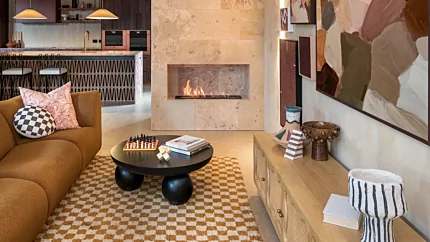
XL900 Ethanol Burner
The published guides on ethanol burners tend to speak past the people who actually specify them. They explain combustion to consumers, repeat the same safety bullet points, and skip the questions a designer or architect needs answered before pulling a model onto a schedule. If you have ever tried to size a burner from a marketing page, you already know the gap. This guide closes it, framing ethanol burners as the precision component they are: a flame engine that you spec into a wall, a plinth, or a bespoke surround.
Loading image...
XL900 Ethanol Burner
Ethanol burners are the flame-producing component of a bioethanol fire, a sealed fuel reservoir with a controlled combustion opening that you specify separately from the surround that conceals it. Unlike a complete fireplace, a burner is a building block. The architect or designer determines the housing, the cladding, the viewing aperture, and the relationship to the room. The burner delivers the flame.
That separation is the whole point. Because bioethanol combustion produces only heat, water vapour, and a small amount of carbon dioxide, no flue, chimney, or gas line is required for indoor use. Vent-free operation removes the structural constraints that normally dictate fireplace placement, opening up freestanding partitions, suspended hearths, fireplace inserts, and joinery-integrated installations that conventional fires cannot support.
A burner is the fuel-and-flame module. A complete fireplace is a finished product that pairs a burner with a glass-fronted firebox, a frame, and a fixed aesthetic. Choose the burner when the brief calls for a bespoke surround or an integration into custom millwork; choose the complete unit when the design intent matches an existing model.
Loading image...

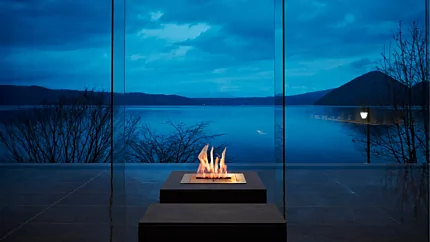
BK5 Ethanol Burner
Clean burning, in the context of ethanol burner specification, means that combustion of denatured bioethanol at 96 to 97 percent purity produces heat, steam, and carbon dioxide as its only by-products. The reaction follows a simple stoichiometric path: C₂H₅OH + 3O₂ → 2CO₂ + 3H₂O. There is no particulate smoke, no soot deposit on adjacent surfaces, and no requirement for a flue to manage exhaust gases.
For specifiers, that chemistry matters at the room scale. Indoor air quality compliance in occupied commercial and residential spaces depends on what enters and exits the air. A bioethanol burner does not introduce wood smoke, fine particulates, or combustion residues, which is why these systems can be integrated into hotel lobbies, gallery walls, and apartment interiors without the extraction infrastructure a wood or gas fire would demand. Adequate ventilation is still required, the same way any occupied room requires fresh air exchange, but the burner itself does not pull a building's mechanical strategy out of shape.
Loading image...
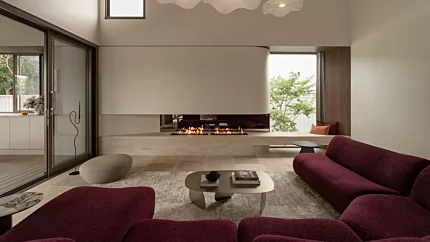 © Comma Projects and Alyne Media
 XL900 Ethanol Burner
Heat output is the figure most specifiers want first, and it is also where the gap between burner specifications and actual room performance shows up. The published EcoSmart Fire range covers a useful spread: the compact AB3 at 1.7 kW (5,800 BTU/hr), the XL500 at 3.36 kW (11,430 BTU/hr), the XL700 at 4.0 kW (13,650 BTU/hr), the XL900 at 4.4 kW (15,000 BTU/hr), and the XL1200 at 4.5 kW (15,290 BTU/hr). The XL Series produces a linear flame suited to long horizontal apertures; the AB Series produces a round flame that suits column-style or central installations.
A useful starting rule for well-insulated interiors with 2.4 m ceilings is roughly 1 kW per 10 m² of floor area, then adjust upward for higher ceilings, exposed glazing, or open-plan adjacencies. A 2024 peer-reviewed study by Ryšavý and colleagues in Energy Conversion and Management found that running an ethanol burner with its regulator partially closed reduces actual heat output to 35 to 40 percent of nominal but extends burn time by up to 195 percent. In practice, design briefs that prioritise ambience over heating can size a larger burner and run it low, which is the opposite of how most specifiers instinctively scale.
Burner type | Flame profile | Typical application |
|---|---|---|
AB Series (round) | Circular, central | Columns, plinths, central focal walls |
XL Series (linear) | Horizontal line | Long apertures, suspended hearths, joinery inserts |
BK5 (compact rectangular) | Short linear | Tight inserts, alcoves, smaller bespoke surrounds |
Loading image...
XL900 Ethanol Burner
The flame regulator is a sliding mechanism that adjusts the size of the combustion opening, varying flame height and fuel consumption in real time. It is the feature that separates a controllable architectural flame from a static one. Sliding the regulator open exposes more fuel surface and increases the flame; sliding it closed reduces output and, fully closed, smothers the flame to extinguish it safely.
For design professionals, that control changes how a burner behaves on site. A dining room flame at low setting reads as ambient light; the same burner at full opening becomes the room's heat source. Pair that with the burn-time extension noted in the regulation research above and a single burner can serve quite different scenes within one project, without committing to a single visual register.
There is also a quiet engineering point worth flagging. EcoSmart Fire's XL Series and AB Series burners carry UL 1370 (USA), EN 16647 (EU/UK), and ACCC certifications, which govern declared heat output, fuel safety, and flame control mechanisms. The regulator is part of what makes those certifications attainable, not a cosmetic add-on.
Vent-free operation is the practical advantage that lets a designer place a flame where the building would otherwise refuse to host one. Sustainable heating, in the sense of a renewable fuel with controllable output and no combustion residues, is the longer-term value that aligns with contemporary project briefs.
When specifying, work back from the room: volume first, flame profile second, surround third. EcoSmart Fire's full burner range covers the practical span of architectural applications, from compact rectangular modules to large linear formats, and the brand's specification team can pair models against project drawings when the brief gets unusual. Designers and architects working on a current project can request specification support directly, or download the technical documentation pack for the relevant model when sizing against room load.