Loading image...

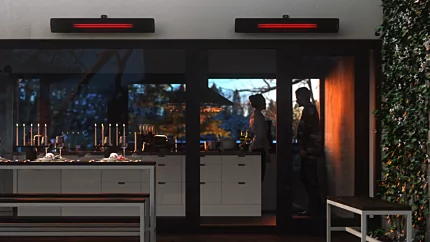
Pure+ 3000W Radiant Heater
When most people think about an outdoor heater, they imagine a tall gas mushroom with a glowing orange coil, a faint roar, and a circle of warm air that drifts away the moment a breeze picks up. That image has shaped a generation of patio and hospitality decisions, and it is the reason so many spaces still end up cold the night someone actually wants to use them.
Modern infrared heaters belong to a different category altogether. They convert 90 to 94 percent of input energy into radiant heat, target bodies and surfaces rather than the surrounding air, and deliver full output in 15 to 30 seconds. The technology has been quietly replacing convective outdoor heating in residential alfresco zones, hotel terraces, restaurant decks, and architect-specified commercial spaces for over a decade.
The gap between the assumption and the reality is wide enough that it tends to dictate the entire shape of an outdoor heating decision.
Loading image...
Pure+ 3000W Radiant Heater
Infrared is electromagnetic radiation that sits just below visible light on the spectrum. When the wavelength meets a body or a surface, the energy converts to heat directly inside the material, the same way the sun warms skin on a cold morning even when the air around you is freezing. There is no intermediate step where the heater warms the surrounding air and the air warms you. That single difference is why infrared works outdoors where a convective patio heater struggles.
The range uses mid-wave infrared, produced by dual carbon spiral elements running at roughly 1,200 to 1,300°C [2,192 to 2,372°F]. The carbon spiral design distributes the load across two elements, which extends element life and allows two-stage output when paired with a 3-gang switch. Filament temperature is the variable that decides which infrared band a heater operates in. Short-wave systems run hotter, glow brightly, and are typically used in industrial applications where visual intensity is not a problem. Long-wave systems run cooler and are used in indoor underfloor or wall-mounted scenarios. Mid-wave sits between them.
Mid-wave infrared is the wavelength band between roughly 1.4 and 3 micrometres, produced by carbon elements at 1,100 to 1,300°C. It is the band that suits residential and hospitality outdoor heating because it is absorbed comfortably by skin and clothing, glows softly rather than glaringly, and reaches a comfort wavelength fast.
The energy leaves the element, crosses the air without significantly warming it, and converts to heat the moment it strikes a person, a chair, a table, or the ground. Within seconds the surfaces in the heated zone are warm; within a minute, those surfaces are radiating low-grade warmth back into the space. This is why a well-positioned infrared heater feels noticeably warmer than the ambient air temperature suggests. According to a 2024 study by Wille and colleagues, infrared heaters required around 38 percent of the end energy of conventional convection heating at equivalent thermal comfort, because raising mean radiant temperature lets occupants feel warm at lower air temperatures.
Short-wave heaters glow too brightly for a candlelit terrace. Long-wave heaters take too long to reach comfort and put too much of their energy into a wavelength that scatters before reaching the seated zone. Mid-wave gives you instant heat, modest glow, and the right absorption profile for human skin. The Spot series reaches at least 94 percent radiant efficiency, the Pure+ and Next models sit at 90 percent or higher, and the Vision at 87 percent or higher.
Loading image...


Loading image...


The five advantages that decide most purchases are direct heat delivery, instant warm-up, zero emissions at point of use, and high energy efficiency. Each of those benefits is grounded in a specific number rather than a marketing claim, which is why the technology is now standard specification in hospitality and increasingly common in design-led residential work.
Direct heat, no wind loss. Infrared targets bodies and surfaces, not the air between them. A breeze can cross a covered alfresco zone without carrying the heat away. Convective heaters, by contrast, warm the surrounding air, and that air drifts the moment it meets ambient. BC Hydro reports that electric infrared radiant patio heaters transfer heat up to 80 percent more efficiently than classical convective heaters in outdoor environments.
Instant warm-up. Heatscope's range reaches full output in 15 to 30 seconds depending on the screen type. The Spot 2800W hits full heat in 15 seconds; the Pure+ 3000W in 15 to 30 seconds; the Vision 3200W in 30 to 60 seconds. A gas patio heater typically takes two to five minutes to reach steady output. For commercial service, where guests arrive and seat themselves in waves, instant heat translates directly to better first impressions.
No combustion, no flue, no emissions at point of use. The range runs on 220 to 240 V mains, with a dedicated 16 A circuit per heater. No flue, no exhaust, no LPG cylinder to swap, no CO risk. The same range covers indoor scenarios where ventilation is constrained and gas is simply not an option. Mushroom-style gas heaters burn LPG and release combustion products into the air around the seated zone, which is the reason gas appliances require at least 25 percent open ventilation in any covered space.
Energy efficiency. Heatscope's models convert at least 90 percent of input energy to radiant heat across most of the range, and at least 94 percent in the Spot series. Convective heaters lose a substantial share of their energy as heated air that drifts upward and out of the seating zone. The energy budget for the same comfort level is significantly smaller with infrared.
Quiet, dust-free, and dry. No blower, no air movement, no dust circulation, no measurable effect on humidity. The myth that infrared dries out the air comes from a confusion with forced-air systems, which move dry air around the room. Mid-wave infrared simply warms bodies and surfaces; it does not move air at all.
There is a smaller cluster of secondary benefits worth mentioning briefly: the carbon filament has a thermal fail-safe built into the element design, the absence of moving parts pushes maintenance close to zero, and the low visible light output makes the heater easy to integrate into design schemes that would visually reject a glowing red coil.
The wind-resistance advantage is the single biggest reason hospitality specifiers switched. A restaurant deck that loses guests every time the breeze picks up is losing revenue, and a deck that keeps guests warm in 12 knots of wind is suddenly a year-round asset. The directional nature of infrared also means the energy can be aimed at the seating zone and nowhere else, which prevents the typical situation where a patio heater is on full output and the people two metres away are still cold.
Electrification of outdoor heating tracks the broader electrification trend across hospitality and residential design. The infrared range is built to slot into that shift: 220 to 240 V supply, smart-home control through ZigBee or the eWeLink Wi-Fi app, and no fuel logistics. The point-of-use emissions profile is zero, and the upstream emissions depend on the grid the heater is connected to. For projects targeting an electric-only build, infrared is the obvious outdoor heating answer.
Most articles on this topic frame infrared as either an indoor heater or an outdoor heater. The reality is that the range covers four distinct application contexts, each with a different IP requirement, a different output profile, and a different fit. Walking through them in order is the simplest way to figure out which model belongs in a given space.
Loading image...

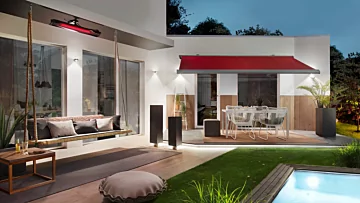
Pure 3000W Radiant Heater
Patios, alfresco zones, pergolas, and balconies are the residential outdoor heartland for infrared. Most of these spaces are covered or partially covered, which puts them in the IP24 zone. The Spot 2800W is the typical residential alfresco fit, mounted overhead or angled from the wall, with a 15-second heat-up and 600 lm of soft light. For an alfresco that is fully exposed to weather, with no roof and no sidewall protection, the install steps up to IP65 and the Pure+ 3000W becomes the right answer. The companion article on open patio heaters covers the outdoor-specific decisions in more depth.
Loading image...


Vision 3200W Radiant Heater
Sunrooms, conservatories, enclosed verandahs, entry vestibules, garages, and workshops all sit in an awkward heating zone. They are too large or too leaky for residential split systems to handle efficiently, but too sheltered to need true outdoor gear. Mid-wave infrared handles these spaces well because it warms people and surfaces directly, ignores the cold spots the air would otherwise carry, and does not stir up the dust that a fan-forced heater inevitably circulates. The sunroom heaters range is designed around this brief. Conservatory and bathroom installs each have their own clearance rules, and the support FAQs cover the specifics.
Loading image...


Vision 3200W Radiant Heater
Restaurant terraces, café outdoor seating, hotel pool decks, event marquees, and rooftop bars share a common requirement: warm guests without disrupting the ambience that brought them in. This is where the design-led infrared models earn their place. The Vision 3200W produces around 300 lm and stays under 300 lux at the heater face, which sits at roughly 30 to 40 percent of the visible light output of a traditional radiant heater. Candlelit service is not broken by red glare, exterior signage is not competing with overhead heaters, and the heater becomes a discreet design element rather than a fixture. The Pure+ 3000W carried home a Red Dot Design Award in 2018 and offers two-stage output along with an IP65 rating for fully exposed deck and pool installations. The hotel and restaurant heaters collection is curated specifically around these specifier requirements.
Loading image...


Pure+ 3000W Radiant Heater
For architect-led residential and commercial work, the visual brief is usually the constraint. A glowing patio heater on a clean minimal ceiling line is visually disqualifying before the heat performance enters the conversation. Heatscope's design language addresses this directly with extruded aluminium chassis options, low-glow output, an optional ceiling-flush lift system on the Spot 2800W and Vision 3200W, colour-matched extension rods in 100, 300, and 500 mm increments, and finish options that include black, white, and the colour palette available on the Vision. Specifier projects almost always land on the Vision 3200W or the Pure+ 3000W, with the Next 3000W picking up the slim-aluminium brief for installations in the US and Canada.
Most residential and hospitality spaces are well served by infrared heaters between 1,600 W and 3,200 W, with output matched to the area covered and the ceiling height. The right wattage depends on the floor area, the ceiling height, the level of weather exposure, and whether the heater needs to span a long table or sit over a compact seating zone.
Wattage | Heatscope model | Coverage area | Typical fit |
|---|---|---|---|
1,600 W | Spot 1600W (US and CA only) | 3 to 5 m² [32 to 54 ft²] | Small balconies, compact zones |
2,400 to 2,800 W | Pure 2400W, Spot 2800W | 5 to 9 m² [54 to 97 ft²] | Typical residential patios and alfresco areas |
3,000 W | Pure+ 3000W, Next 3000W | 8 to 10 m² [86 to 108 ft²] | Larger residential and small commercial zones |
3,200 W | Vision 3200W | up to 11 m² [118 ft²] | Large zones, design-led environments, long banquette spans |
The Spot 1600W is a useful small-zone heater but is available in the US and Canada only. The Next 3000W carries the same regional caveat. The Vision 3200W is the widest format in the range at 1,661 mm [65.4 in], which lets a single heater span a six-person dining table without leaving cold edges.
The lower edge of the unit should sit 1.8 m [70.9 in] above the floor as a minimum. Ceiling heights between 2.4 and 3 m [7.9 and 9.8 ft] suit most residential installs without additional accessories. Commercial spaces with ceilings above 3 m benefit from extension rods in 100, 300, or 500 mm [3.9, 11.8, or 19.7 in] increments to bring the heater face into the comfort zone above the seating area. High-ceiling commercial scenarios are the one place where wattage calculation alone is not enough, and the answer almost always includes extension rods or a different mounting strategy.
An infrared heater's IP rating tells you how exposed an installation it can survive. The range covers IP24 for covered patios, IP25 for all-weather installs, and IP65 for fully exposed outdoor environments. The two digits in the rating come from the IEC 60529 standard: the first digit covers protection against solids, and the second covers protection against water.
The Spot 2800W and Vision 3200W carry an IP24 rating, meaning they are protected against solids over 12 mm and against splashing water from any direction. This is the right rating for a well-covered patio or balcony under an overhang or pergola roof, where direct rain does not reach the heater. An optional Weathershield accessory is available for installs that are borderline.
One step up is IP25, which the Next 3000W (US and Canada only) achieves. IP25 adds protection against water jets from any direction, which covers pergolas with open sides and partly covered terraces where prevailing winds carry rain under the roofline.
At the top of the range is IP65, carried by the Pure+ 3000W fitted with its SCHOTT NEXTREMA® glass screen. IP65 means the unit is fully dustproof and protected against water jets from any direction, which makes it the only model rated for fully exposed installations on open rooftop decks, uncovered courtyards, and exposed pool decks. The install pattern for an IP65 unit is more involved than for IP24 because it requires a wet-room distribution box on the supply cable, but it is the only option when the heater is going to live in the weather. The Pure+ 3000W product page carries the full IP65 install diagram and the accessory list for exposed environments.
A practical decision rule. Stand under your installation location and look up. If you see sky, you need IP65. If you see roof but rain reaches the wall behind, you need IP25. If you see roof and the space is properly covered, IP24 is enough. That single test settles the IP question before anyone needs to read the rating chart.
For most outdoor heating decisions, the real comparison is not between infrared models, it is between infrared and gas. The two technologies sit on opposite sides of the heat-delivery question, and the comparison tends to decide the budget, the install pattern, and the long-term running profile of the space.
Factor | Infrared (mid-wave electric) | Gas patio heater |
|---|---|---|
Heat delivery | Targets bodies and surfaces directly | Heats surrounding air, which drifts |
Warm-up time | 15 to 30 seconds | 2 to 5 minutes to steady output |
Emissions at point of use | None | Combustion products including CO₂ and water vapour |
Fuel supply | 220 to 240 V mains, dedicated 16 A circuit | LPG cylinders, refills, storage, replacement logistics |
Visual impact | Low glow, 300 to 600 lm | Visible flame, larger footprint |
Acoustic | Silent | Audible burn |
Coverage shape | Directional, predictable | Omnidirectional, weather-dependent |
Wind performance | Largely unaffected | Heat carried away by breeze |
Energy conversion | ≥90 percent of input energy to radiant heat | Substantial share lost as heated air drifting from the seating zone |
Gas still has a case in scenarios where there is no electrical supply available, where a portable cylinder model is the only option, or where the open-air space is so large that the omnidirectional output is genuinely useful. For a covered residential alfresco or a hospitality terrace with seating zones to target, infrared is the technology the brief was actually asking for.
Loading image...


Vision 3200W Radiant Heater
That 300 lm / sub-300 lux figure from the Vision 3200W does most of the work when hospitality specifiers make their shortlist. In a candlelit restaurant or a low-lit hotel terrace, the difference between a heater that disappears into the design and a heater that becomes the brightest object in the room comes down to a single luminance figure. The same number explains why lighting designers tend to be more vocal about heater aesthetics than the heater industry itself recognises, which is a small irony given how much time hospitality teams spend tuning the rest of the lighting plan.
Materials and finish do most of the rest. The chassis on the Vision 3200W is extruded aluminium, the screen is ceramic glass, and the colour palette extends past the standard black-or-white default into the architectural finish range. The Pure+ 3000W uses SCHOTT NEXTREMA® convex glass as its front screen, which is the same family of glass-ceramic that gets specified on premium induction cooktops, and the model carried a 2018 Red Dot Design Award home as third-party validation of the design work.
Architectural integration options matter once the heater enters a serious specification environment. The Spot 2800W and Vision 3200W both accept an optional lift system that flush-mounts the unit into a ceiling cavity, hiding the heater entirely when it is not in use. Extension rods in 100, 300, and 500 mm increments let the installer drop the heater face into the comfort zone on a high ceiling without leaving an awkward gap above. Colour-matched mounts close the visual gap between the heater and the ceiling plane it is fixed to.
Installation is straightforward but not trivial. The electrical requirement is 220 to 240 V on a dedicated 16 A circuit per heater, and a licensed electrician is required for the install. IP65 installs add a wet-room distribution box on the supply cable. None of this is unusual for a hard-wired electrical appliance, but it does mean the install needs to be planned at the same time as any other electrical work on the space.
Clearance requirements across the range:
1.8 m [70.9 in] from floor to the lower edge of the unit
170 mm [6.7 in] from the ceiling on ceiling-mount installations
406 mm [16 in] from vertical surfaces such as walls and pillars
1.5 m [59 in] from textiles, curtains, blinds, awnings, or other flammable materials
There are a handful of environments where infrared heaters do not belong. Indoor swimming pool halls expose the elements to chlorine, which corrodes the carbon filament over time. Salt-air locations within 100 m of breaking surf shorten element life through corrosion. Installations within 1 m of a shower or bath, or within 2 m of a pool edge, sit outside the safe envelope and require a different mounting strategy.
Smart control runs through ZigBee, which works directly with Alexa and Google Assistant, or through the eWeLink Wi-Fi app. The two-channel control across the carbon spiral elements means each element can be operated independently when paired with a 3-gang switch, giving a two-stage output for low-and-high comfort settings. The range carries a 2-year limited warranty. A competent electrician can complete a typical residential install in a few hours, and the support library on each product page covers the specifics in detail.
A four-question decision flow gets most people to the right model quickly. Start with exposure: if the install is fully exposed to weather, the Pure+ 3000W (IP65) is the only choice and the question is settled. If the space is sheltered, move to size: spaces larger than 9 m² or a single heater spanning a long table or banquette call for the Vision 3200W. Within the covered-patio range, a zone of 5 to 9 m² that needs fast directional heat is a Spot 2800W job, with the Spot 1600W available for smaller zones in the US or Canada. For an all-weather pergola install in the US or Canada where a slim aluminium profile is the brief, the Next 3000W is the answer; otherwise, loop back to the exposure question and start again.
For full spec sheets, finish options, and the accessory range, the radiant heaters collection is the natural next destination. The companion article on outdoor heating solutions covers the alfresco use case in deeper detail, and the support library carries the installation manuals and clearance diagrams for each model.
Mid-wave infrared is a different category of heat from the gas mushrooms and convective heaters most people assume when they start a search. It targets bodies and surfaces directly, reaches full output in seconds, holds heat in a breeze, and integrates into design-led spaces in a way that traditional patio heating simply cannot match. The right model depends on three factors that the article has now walked through: how exposed the install is to weather, how large the area covered needs to be, and what kind of ambience the space is asking for. For a covered patio, a Spot. For a fully exposed deck, a Pure+. For a long banquette or a design-led restaurant, a Vision. With the technology and the sizing settled, the rest is an installer's afternoon.