Loading image...
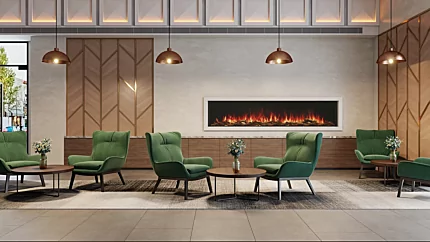
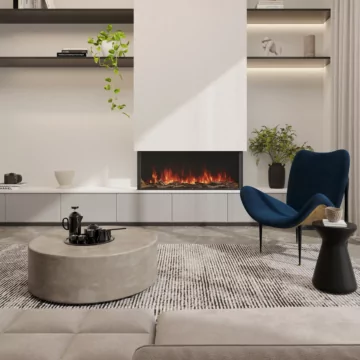
Switch 80SS Electric Fireplace
You're about to spend serious money on a fireplace you'll live with for the next ten or twenty years, and most of the buying guides out there will hand you a list of features and wish you luck. That isn't how the decision actually works. The difference between a fireplace you love and a fireplace you tolerate almost always comes down to four or five technical questions buyers don't know to ask before they place the order, and an electric fireplace buying guide that leaves those questions on the table isn't really a guide at all.
This one walks through every one of them. We'll work through the eight decisions every buyer has to make, in the order they actually come up: the underlying flame technology, sizing the unit to the wall and the room, picking the right voltage and circuit, matching heating output to the space, deciding between indoor-only and indoor-plus-outdoor placement, choosing between wall-mount, recessed, and built-in installation, understanding the real running cost, and making the fireplace fit the room visually.
Loading image...
Switch 80SS Electric Fireplace
An electric fireplace is a self-contained, zero-clearance, vent-free heating and ambience appliance powered by mains electricity. It generates a flame effect using LEDs and reflective optics, optionally outputs heat through a resistive element, and sits inside an enclosed cabinet that doesn't need a flue, a gas line, or a non-combustible surround.
Three things every electric fireplace is, and three things it isn't.
A flame effect, running on a low-wattage LED system that produces ambient light and the look of fire without combustion.
An optional electric heater, which can be switched on independently of the flame on most models.
An enclosed cabinet, sealed to the wall or set into a cavity, with no external venting requirement.
A primary heat source for a whole house: electric fireplaces are sized for zone heating, not central heating.
A vented appliance: no flue, no chimney, no combustion air requirement.
A fuel-burning fire: no wood, no gas, no bioethanol, and no flame that can actually burn anything inside the cabinet.
The reason that distinction matters is that a fair number of buyers come to electric fireplaces expecting a like-for-like replacement for a wood-burner or a gas insert. They aren't. They're a different category of product solving a related but distinct brief: design-led ambience with controllable supplementary warmth, available in rooms and walls that no combustion fireplace could reach. Our electric fireplaces range is engineered around exactly that brief, with both Motion and Switch built as zero-clearance, vent-free units from the ground up.
Before you start comparing models, work through these eight questions in order. They map directly to the sections that follow, and once you've answered them, the right fireplace is usually obvious.
Technology: Motion Picture Flame Technology or Switch FX Technology?
Size and orientation: what wall length and viewing height do you have to work with?
Voltage and circuit: is the installation 120 V or 240 V, and do you have the dedicated circuit it needs?
Heating output: how many square metres does the fireplace actually have to warm?
Placement: indoor only, or indoor and outdoor under a patio cover or overhang?
Installation type: wall-mount, recessed flush, or fully built into joinery?
Running cost: flame-only ambient mode or flame-plus-heat, and how often each?
Design fit: finish, framing, accessory media, and how the unit reads in the room.
The order isn't arbitrary. Technology shapes everything downstream, because Motion and Switch differ in depth, in size steps, and in whether they can go outside. Size sets the framing brief for installation. Voltage determines what coverage you can plan for. Skip a question and you'll be the buyer who specifies the unit, finishes the wall, and then discovers there's no 20 A circuit waiting for it.
Loading image...
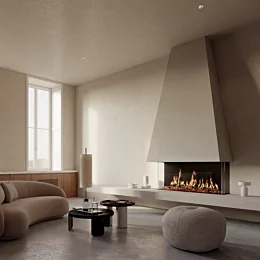
Motion 60BY Electric Fireplace
Loading image...

Switch 44BY Electric Fireplace
The single biggest decision, and one no other brand actually presents this way, is which of our two flame technologies suits the project. They aren't different finishes of the same product. They're engineered for different briefs.
Motion Picture Flame Technology produces multi-dimensional flames with three selectable flame styles and integrated wood-crackling audio. It's the more cinematic option, designed for indoor rooms where the fireplace is the focal point of an evening, and it sits at a slimmer 9.4-inch [240 mm] depth. The audio runs through a built-in speaker, the flame styles cycle through traditional, contemporary, and accent profiles, and the entry size is a 30-inch [762 mm] wide unit with the largest reaching 124 inches [3,150 mm].
Switch FX Technology produces adjustable flame patterns with accent-colour customisation. It's the only one of our electric ranges rated for outdoor installation under a patio cover or overhang, which makes it the answer for any alfresco or covered-outdoor brief. Switch sits at 11.5-inch [292 mm] depth, starts at a 44-inch [1,118 mm] wide unit, and scales to 120 inches [3,048 mm].
Three questions resolve the choice almost every time.
Question | Motion | Switch |
|---|---|---|
Where will it live? | Indoor only | Indoor or covered outdoor |
Cabinet depth | 9.4 in [240 mm] | 11.5 in [292 mm] |
Entry size | 30 in [762 mm] wide | 44 in [1,118 mm] wide |
Largest standard size | 124 in [3,150 mm] wide | 120 in [3,048 mm] wide |
Wood-crackle audio | Yes | No |
Flame styles | Three selectable styles | Adjustable patterns with accent colours |
Accessory media | Western Driftwood Logs, Black Crushed Glass | Canyon Driftwood Logs, decorative media |
If you want the deepest possible indoor flame effect with audio, lean Motion. If the brief includes outdoor placement, or you want the widest customisation palette of accent colours, lean Switch. If the wall framing is shallow, that 9.4-inch versus 11.5-inch difference will quietly make the call for you. The deep-dive on the underlying optics, layered reflections, and LED arrays sits in a separate flame-technology article in this cluster, because the mechanics deserve more room than a buying guide can give them.
There are two sizing decisions buyers tend to merge into one, and they shouldn't. Visual sizing matches the fireplace width to the wall it lives on. Heating sizing matches the unit's output to the room it has to warm. The first is a design question, the second is a thermal one, and the right answer to each is rarely the same number.
For visual sizing, a useful rule of thumb is that the fireplace should occupy somewhere between 50 and 70 per cent of the available feature-wall width. Less than half and the unit looks lost; more than 70 per cent and it crowds the framing and surrounding joinery. Stand in the room, measure the wall the fireplace will sit on, and work from there. The TV mounted above (if there is one) and any flanking joinery want to read as one composition, not three.
Our Motion range covers a wide spread of standard widths: 30, 52, 60, 76, 100, and 124 inches. Switch starts a little wider at 44 inches and steps through 56, 68, 80, 96, and 120 inches. Heights are consistent within each range, which helps when you're laying out vertical sightlines: Motion sits at 23.9 inches [607 mm] tall, Switch at 24.9 inches [632 mm]. That consistency matters when you're aligning the top of the fireplace with a horizontal joinery line or a TV mount above.
A quick wall-length-to-fireplace-width starting point:
2.5 m wall (about 8 ft): 30 to 60 inch unit
3.5 m wall (about 11 ft): 60 to 80 inch unit
5 m wall (about 16 ft): 96 to 124 inch unit
Both Motion and Switch ship voltage-flexible: configured for 120 V (the North American standard) or 240 V (Europe and the UK). The voltage choice isn't cosmetic. It changes what the unit can do.
Voltage | Heater output | BTU/h | Approx. coverage | Circuit |
|---|---|---|---|---|
120 V | 1,500 W | 5,000 BTU/h (1.5 kW) | ~28 m² / 300 ft² | Dedicated 20 A |
240 V | 3,000 W | 10,000 BTU/h (2.9 kW) | ~56 m² / 600 ft² | Dedicated 20 A |
On 120 V, the heating element draws 1,500 W and produces around 5,000 BTU/h, which is good for a single sitting area up to about 28 m² (300 ft²). On 240 V, the element doubles to 3,000 W and 10,000 BTU/h, roughly twice the coverage at around 56 m² (600 ft²). That's the lever that opens up larger open-plan rooms to electric heating.
Both voltages need a dedicated 20-amp circuit. That requirement is the single most common pre-install surprise, and it's the one that holds projects up at the worst possible moment, after the wall is opened and the unit is on site. A standard household power outlet on a shared circuit doesn't satisfy it. Before you order, walk the supplier or your electrician through the circuit you've earmarked: dedicated, 20 A, and on a breaker the heating element can have to itself.
The LED flame-only draw is much smaller. Across the Motion and Switch electric fireplaces, it sits between 30 W at the smallest end of Motion and 106 W at the largest end of Switch, which is closer to a household incandescent bulb than to a space heater. That distinction matters when you're modelling running cost in the ambient months of the year, which we'll come back to in Decision 7.
The fastest way to misuse an electric fireplace is to expect it to do the work of a central-heating system. It won't. Electric fireplaces are supplementary heat, designed for the room you're sitting in, not the whole house. Used that way, they're effective and inexpensive to run. Used as a primary heat source for a three-bedroom home in winter, they'll disappoint everyone involved.
The right framing comes from the US Department of Energy, which recognises zone heating as a proven energy-saving strategy: heat the room you're using, lower the demand on the central HVAC system, and the total household energy bill comes down. Electric fireplaces are one of the most accessible ways to put that into practice.
In practical room-size terms, the voltage choice from Decision 3 sets the brief:
Small room or single sitting area (up to 28 m² / 300 ft²) → 120 V configuration, 1,500 W, 5,000 BTU/h
Open-plan living area (up to 56 m² / 600 ft²) → 240 V configuration, 3,000 W, 10,000 BTU/h
Whole-house heating → not the right product category; reconsider the brief
Three variables affect those numbers in real rooms: insulation quality, ceiling height, and climate. A 50 m² open-plan room with three-metre ceilings, single-glazed windows, and a Melbourne winter draft will demand more from any heater than the same floor area in a tightly insulated newer build. The figures above assume reasonable insulation and a 2.4 m ceiling. Adjust your expectations upward if either is off.
If after working through this you realise you actually need primary heat, an electric fireplace probably isn't the right tool. Our bioethanol ranges sit in the higher-output category and are suited to buyers who need primary rather than supplementary heat, but those are combustion appliances with different planning requirements. They aren't electric. Note the distinction before you cross the line between the two categories.
Most electric fireplaces on the market are indoor-only. The Switch range is the one that breaks that pattern, certified for installation under a patio cover or overhang. For buyers planning an outdoor room, an alfresco lounge, or a covered terrace, Switch is the answer in the electric fireplaces collection. For purely interior projects, Motion is the deeper, more cinematic option.
The phrase "outdoor-rated" trips people up, so it's worth being precise. Outdoor-rated does not mean weather-exposed. The Switch unit needs to live under a structural cover that protects it from direct rainfall and lateral driving rain. A pergola with closed-louvre slats works. A roof eave with at least 600 mm of overhang works. An open pavilion in a windy coastal location does not.
Outdoor placement requirements, in short:
A structural cover above the unit that prevents direct rainfall reaching the cabinet
Adequate clearance from soft furnishings, curtains, and combustible materials at the front
Drainage and ambient airflow around the location so the surrounding wall stays dry
The same dedicated 20 A circuit as indoor installation, with weatherproofed wiring run to code
When the brief includes both an indoor living area and a covered outdoor lounge, specifying Switch in both spaces is the cleanest solution: one technology, one accessory vocabulary (Canyon Driftwood Logs across both), and a consistent finish reading across the project. That's a meaningful lever for landscape architects and designers running outdoor-room briefs.
Three installation approaches, three different demands on the wall. The right choice depends on how invisible you want the unit to be and how much joinery work the build will tolerate.
Wall-mount sits proudly on the surface of the wall with the cabinet visible. No cavity work, no framing change, just brackets into studs. It's the fastest path to install and the easiest to retrofit into an existing room.
Recessed sits flush with the wall face. The fireplace cabinet is set into a cavity in the wall framing, with only the front face exposed. This is the cleaner-looking option, and the one most architects gravitate toward, but it requires the cavity depth to match the unit.
Built-in is set inside a custom joinery surround or a feature wall designed around the fireplace. It's the premium-tier specification for high-end projects, where the fireplace becomes one element in a designed wall composition that might include shelving, integrated TV, lighting, and surround materials.
The cavity depth is where the difference between Motion and Switch becomes a practical consideration rather than a preference. Motion is 9.4 inches [240 mm] deep. Switch is 11.5 inches [292 mm] deep. A standard 2x4 stud wall in North America gives you 3.5 inches of stud depth plus a half-inch of drywall on each face, which is nowhere near deep enough for either unit. Both ranges need framing modifications: either deeper studs, a bumped-out section in the wall, or framing built proud of the existing surface. Motion's two-inch advantage means it slips into projects with tighter wall depths that Switch can't accommodate, and that detail tends to be the deciding factor more often than people expect.
Wall-cavity planning, frankly, is the unsung hero of every fireplace install. Get it right at the framing stage and the rest of the build is straightforward; get it wrong and you're rebuilding a wall after the trades have left. Worth a second walk-through with the builder before drywall goes up.
Both ranges are zero-clearance, which means the cabinet itself doesn't require non-combustible surrounds. The wall framing can be timber. The surrounding finish can be timber-veneered joinery, painted MDF, or wallpaper. What still applies is a three-foot (0.9 m) front clearance for soft furnishings: throws, curtains, rugs that drape, anything that could overhang the front face of the unit while the heater is running.
Competing buying guides tend to wave at "energy-efficient" and move on. The actual numbers are more useful. Running cost depends on which of two modes the fireplace is in: flame-only, which is the ambient mode you'll use year-round, and flame-plus-heat, which kicks in during the colder months.
Mode | Power draw | Approx. cost per hour |
|---|---|---|
Flame only (LED) | 30 to 106 W | Roughly 2 cents (US average tariff) |
Flame + heat (120 V) | 1,500 W | Roughly 24 cents (US average tariff) |
Flame + heat (240 V) | 3,000 W | Proportionally higher; varies by tariff |
A Verde Energy analysis of 117 electric fireplaces found they convert 100 per cent of the electricity consumed directly into heat, which is technically more efficient than gas fireplaces at 70 to 90 per cent. Direct Energy estimates running costs for an electric fireplace at full heat at roughly USD 10 to 13 per month under typical household use, which is a fraction of a gas or wood-burner monthly running cost.
Flame-only is where the value really lands, though. At 30 to 106 W depending on model, the LED system draws about the same as a household lighting circuit. If you're using the fireplace for ambience on a warm evening, the cost is closer to running a couple of bedside lamps than to running a heater.
A practical note on how the two ranges handle the modes: Switch lets you run flame and heat independently, so the LED flame can be on with the heater off, or vice versa. On Motion, the heater only runs when the flame is on. That's a deliberate design choice: the flame is the product, the heater is supplementary. It's worth knowing in advance if you imagined running the unit purely as a heater with the lights off. Neither approach is wrong, they're just different operating logics, and the energy efficiency claim still holds across both.
Past the technical decisions, the fireplace still has to sit in a room and earn its place visually. Both Motion and Switch share the same material palette: Mild Steel cabinets with a Satin Powder-Coat finish, Toughened Glass Fire Screens, and a consistent black finish across the range. That consistency matters in projects with more than one fireplace; specify Motion in the lounge and Switch on the terrace, and the architectural finish vocabulary reads as a single composition rather than two unrelated products.
The accessory media is where the two ranges diverge. Motion takes Western Driftwood Logs and Black Crushed Glass, which lean into a deeper, more naturalistic flame profile. Switch takes Canyon Driftwood Logs and a wider set of decorative media options, which pair with the accent-colour customisation to create a more configurable visual signature. Neither is more "correct" than the other; they're tuned to different design intentions.
The bigger design freedom is what the technology unlocks. A vent-free, zero-clearance, voltage-flexible fireplace is not constrained by flue routing, structural beam locations, or external wall access. That widens the design palette considerably. A fireplace can sit on a freestanding feature wall in the middle of an open-plan room. It can be specified into an interior wall with no exterior access. It can be placed below a TV without a flue header complicating the geometry. It can be installed in an apartment on the twentieth floor, in a basement room with no chimney route, in a heritage building where structural modifications are out of the question, and on a covered terrace, all from the same range.
Those placements are difficult or impossible with a flue-dependent appliance. The fact that they're routine with electric is the design story behind the category, and the reason architects increasingly specify electric fireplaces into projects they couldn't have considered a decade ago.
If you've worked through the eight decisions above and want a single-screen way to land on the right unit, run the project through this in order. The first answer that fits is usually right.
Is it going outdoors under cover? -> Switch. Motion is indoor only.
Indoor only, and you want wood-crackle audio with the deepest flame effect? -> Motion.
Indoor only, and you want the widest accent-colour customisation palette? -> Switch.
Does the room need more than 28 m2 (300 ft2) of heating coverage? -> Specify the 240 V configuration.
Is the wall framing shallower than 11.5 inches available cavity? -> Motion's 9.4-inch depth fits standard framing scenarios Switch can't.
Do you actually need primary heat for the whole house? -> Reconsider the brief; electric fireplaces are supplementary.
Project includes both indoor and outdoor zones and you want consistent technology across both? -> Switch in both.
Heritage building, apartment, no-flue installation? -> Either range; the zero-clearance, vent-free design solves the problem.
That tree resolves about 90 per cent of the buying decisions we see. The other 10 per cent come down to the specifics of the wall, the joinery brief, and the existing room composition, and that's the point at which the supplier conversation becomes useful rather than premature.
Five things to confirm before you place the order. Each one corrects a different category of pre-install surprise.
Confirm wall depth and framing. Measure the cavity available and compare it to the chosen unit's depth (9.4 inches for Motion, 11.5 inches for Switch). Confirm with the builder whether the framing will need modification.
Confirm the dedicated 20 A circuit. Walk the location with an electrician. A shared household outlet does not satisfy the requirement. The circuit needs to be dedicated and on its own breaker.
Confirm voltage with the supplier. 120 V for North America, 240 V for Europe and the UK. The unit is wired and tested for the chosen voltage at the factory, so this is an order-stage decision, not a post-delivery one.
Confirm indoor or outdoor placement. For outdoor projects, confirm Switch and confirm a structural cover protecting the unit from direct rainfall. Indoor projects can go with either range.
Confirm the size matches the wall, not just the room. Measure the feature wall, apply the 50 to 70 per cent rule, and cross-check against the available standard widths. If standard sizing doesn't hit cleanly, ask about custom widths at the specification stage.
Once those five are confirmed, the installation itself is straightforward. The lead time and shipping window will become the gating items at that point, not the technical questions.
The right electric fireplace isn't the one with the most marketed features. It's the one matched to the wall, the room, the wiring, and the way the household actually intends to use it, for ambience most evenings, for warmth when the temperature drops, and for the design composition the room is trying to land. Those four match-ups are the whole job.
A well-chosen electric fireplace is a ten-to-twenty-year design decision, and the questions in this electric fireplace buying guide are the ones that get it right the first time. Once the eight decisions are answered, the rest of the conversation with your supplier is short. Whether the unit ends up being Motion or Switch, indoor or covered outdoor, 120 V or 240 V, the difference between satisfaction and regret usually comes down to whether the buyer asked the right questions before the wall was framed.