Loading image...

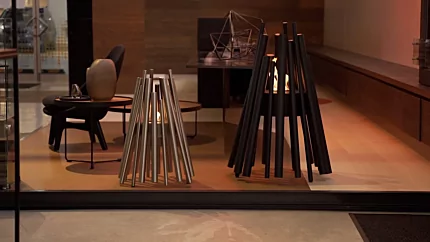
Stix Fire Pit Series
Indoor flame is one of the last places where sustainability and comfort still pull in opposite directions. A timber fire fills a room with fine particles that modern air quality science no longer treats as harmless. A gas or LPG fire pit needs flues, licences, and building work that put it out of reach for most living rooms.
Bioethanol sits in a different category. It is a renewable liquid fuel that can be burned in certified, flueless fireplaces designed specifically for habitable interiors.
Loading image...
Stix Fire Pit Series
Most indoor "fires" force you to choose between atmosphere and air quality. Burning wood inside a home is the most visible example. The World Health Organization's 2021 air quality guidelines halved the recommended safe annual exposure level for PM2.5 to just 5 µg/m³, reflecting evidence that fine particulate matter is responsible for roughly seven million preventable deaths every year. Wood combustion in homes routinely produces PM2.5 concentrations in the several hundreds of µg/m³, well above the interim targets WHO has set for residential air quality. A cosy log fire and a clean indoor airshed are, in practice, two different rooms.
Gas and LPG fires are not the answer either. In most jurisdictions they are simply not permitted inside habitable rooms without dedicated flue construction, gas-fitter certification, and combustion-air provisioning. Electric flame effects sidestep the combustion question, but they don't sidestep the energy question: their carbon footprint is whatever the local grid happens to be, which in many markets is still majority fossil-fuelled.
That leaves one category of open flame engineered specifically for sealed interior spaces: bioethanol. Browsing the indoor fire pit range is the easiest way to see what indoor-rated combustion actually looks like in product form. The rest of this article explains, with sources, why bioethanol is the only renewable open-flame option that lines up with the way modern building codes and air quality science treat interior environments.
Loading image...


Bioethanol is an alcohol fuel fermented from agricultural sugars, usually corn, sugarcane, sugar beet, or wheat starch. e-NRG Bioethanol, the fuel formulated for EcoSmart Fire burners, is refined to a high-purity ethanol specification that combusts cleanly and consistently. The environmental story sits inside the carbon cycle itself.
The carbon cycle in three steps:
Crops absorb atmospheric CO2 as they grow, building it into plant tissue through photosynthesis.
Those crops are harvested, fermented, and distilled into ethanol, which is the energy carrier you eventually burn.
Combustion releases the same carbon back into the atmosphere as CO2, which the next season's crop absorbs again.
International accounting frameworks recognise this loop. According to the U.S. Energy Information Administration, CO2 emissions from burning biofuels are not counted in national greenhouse gas inventories because growing the feedstock plants offsets the CO2 released during combustion. Peer-reviewed lifecycle assessments confirm the same "net zero" treatment of biogenic CO2 that underpins bioethanol's carbon position.
Where bioethanol isn't a free pass: agricultural inputs, fermentation energy, and transport all carry their own emissions, and the size of the lifecycle reduction depends on how the crop was grown and where the energy came from.
Bioethanol is the only certified renewable open-flame fuel that can legally and safely be burned inside a sealed habitable interior. Gas and propane appliances require flues, certified installation, and combustion-air provisioning that exclude them from most living rooms; wood combustion releases fine particulate matter at levels that breach WHO indoor air guidelines; gel fuels lack the indoor certifications bioethanol carries. That sentence is the article's load-bearing claim, so it's worth unpacking on the chemistry, the regulations, and the honest caveats.
The chemistry first. Bioethanol combusts to heat, water vapour, and carbon dioxide, in a stoichiometric reaction that does not produce smoke, soot, ash, creosote, or smouldering particulates the way wood does. WHO's household air pollution guidance explicitly classifies alcohol fuels among the clean fuel solutions for residential use, alongside solar, electricity, biogas, LPG, and natural gas. That classification matters, because the same guidance attributes 2.9 million deaths a year to household air pollution from biomass and coal combustion, with indoor smoke in poorly ventilated dwellings reaching fine particle concentrations a hundred times higher than acceptable.
The regulations next. Indoor-rated bioethanol fire pits in the EcoSmart Fire range are certified to the testing protocols that govern the three major markets: UL 1370 in the United States and Canada, EN 16647 in the UK and Europe, and the ACCC's Safety Mandate in Australia. These are the regulatory bodies whose ventilation, flame-stability, and combustion-safety testing confirms that a flueless ethanol burner can operate inside a habitable room when the room is sized and ventilated appropriately. The certifications are the difference between a decorative ethanol product and one engineered for an interior fit-out.
The honest caveat. Indoor-rated does not mean ventilation-free. A 2026 peer-reviewed study in the Journal of Hazardous Materials by Vicente and co-authors tested ethanol fireplaces under deliberately minimal ventilation and found that combustion can raise indoor formaldehyde and NO2 above WHO guideline values when the room is sealed up. The conclusion that matters: bioethanol's clean-combustion case holds in an appropriately sized and ventilated space, which is exactly how the certification standards require these products to be installed. Adequate room volume and air exchange are non-negotiable. Specific ventilation maths, clearance dimensions, and installation steps are covered in the dedicated indoor ventilation and safety guide rather than duplicated here.
The table below summarises the regulatory and environmental position of the main indoor flame options.
Fuel type | Indoor-rated? | Combustion by-products | Renewable? |
|---|---|---|---|
Bioethanol | Yes, certified to UL 1370, EN 16647, and ACCC | Heat, water vapour, low CO2 | Yes, fermented agricultural sugars |
Wood | No in most building codes | PM2.5, PM10, creosote, CO | Renewable but high-emission |
Natural gas / LPG | No without flue and certification | CO2, water vapour, trace NOx | No, fossil-derived |
Gel fuel | Limited; lacks broad indoor certification | Variable; often contains methanol | Partial |
Electric flame effect | Not a combustion source | Grid-dependent | Depends on grid mix |
The eco case for a bioethanol fire pit doesn't begin and end at the burner. There's a lifecycle around the product that contributes as much to its environmental footprint as the fuel itself, and on this front bioethanol fire pits do unusually well compared to most heating appliances.
Zero install carbon. A bioethanol fire pit needs no gas line, no flue, no chimney, no ductwork, no electrical hardwire. The product is the install. Compare that to a built-in gas fireplace, which carries the embodied emissions of metal flueing, structural framing modifications, and certified gas fitting before its first flame.
Material durability. Stainless steel grades in Stix and Stix 8 are designed for decades of service and are fully recyclable. Fluid Concrete in Pod 30 and Pod 40 is engineered as a structural composite, not as a finish that flakes off after a few seasons. Burner components are serviceable rather than disposable.
Portability and reuse. A freestanding bioethanol fire pit can move between rooms, between houses, or from a residential setting into a commercial fit-out, without losing its function. The same unit can serve a household for twenty years and then a second owner for the next twenty.
Zoned heating efficiency. Unlike central heating, which conditions a whole house regardless of where you actually are, a bioethanol fire pit warms the occupied zone. Paired with a slightly lower thermostat setting elsewhere in the home, it shifts heat into the room you're using and away from the rooms you're not.
A short aside, because it's worth saying out loud: the best sustainability story is almost always the one that lasts long enough to keep telling itself. A product designed to be lived with for two decades does more for the planet than five fashion-cycle replacements ever will, regardless of what's printed on the label. Considered design is a quiet form of climate action, and the indoor fire pit category is one of the rare places it shows up unambiguously.
Loading image...

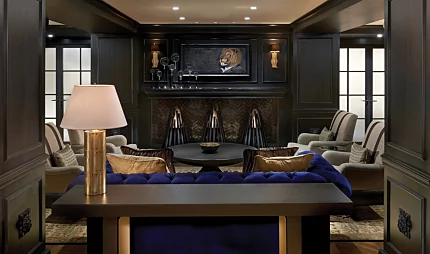
The environmental conversation around indoor fire features is increasingly a procurement conversation, not just a homeowner one. ESG-aware specifiers, sustainability officers, and hotel design teams are asking the same questions architects asked a decade ago, with an additional emissions-disclosure layer on top.
The bioethanol indoor case looks like this. Renewable fuel input, no fossil-fuel utility connection, no flue or combustion-air infrastructure to specify, internationally recognised combustion safety certification across the major markets, and a documented BTU and burn-time profile that finance teams can model into facility energy plans. That's a defensible scope of disclosures, not a vibes-based eco claim.
The point isn't that the fire pit hides the sustainability argument inside the guest experience. The point is that the same product delivers both. A renewable, certified, flueless flame is a procurement story and a guest-experience story sitting inside one specification line. The full design, safety, and compliance breakdown for commercial fire pit specifications lives in the dedicated commercial guide.
Indoor heating doesn't have to choose between atmosphere and sustainability. Bioethanol is the part of the category that resolves the choice: a renewable, certified, open-flame fuel that has been engineered, regulated, and tested for the interior spaces people actually live and work in. The case is strongest precisely where the alternatives are weakest, which is exactly the room you're sitting in right now.
The practical expression of that case is the indoor-rated EcoSmart Fire range: Stix, Stix 8, Pod 30, Pod 40, and the ethanol Fire Pit Kit family, each carrying the certifications, burn-time data, and material credentials covered above. Picture an evening in your living room where the fire is already lit, there's no smoke, no flue, no fossil-fuel meter ticking, and the warmth in the air comes from a litre of fermented plant sugar. That's not a hypothetical; that's the category.